May 2024
Intermediate to advanced
366 pages
7h 58m
English
The API server is the gateway to the Kubernetes cluster. Any human user, client (e.g., kubectl), cluster component, or service account will access the API server by making a RESTful API call via HTTPS. It is the central point for performing operations like creating a Pod or deleting a Service.
In this chapter, we’ll focus on the security-specific aspects relevant to the API server. For a detailed discussion on the inner workings of the API server and use of the Kubernetes API, refer to Managing Kubernetes by Brendan Burns and Craig Tracey (O’Reilly).
Figure 17-1 illustrates the stages a request goes through when a call is made to the API server. For reference, you can find more information in the Kubernetes documentation.
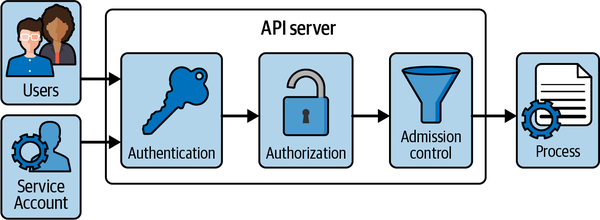
The first stage of request processing is authentication. Authentication validates the identity of the caller by inspecting the client certificates or bearer tokens. If the bearer token is associated with a service account, then it will be verified here.
The second stage determines if the identity provided in the first stage can access the verb and HTTP path request. Therefore, ...
Read now
Unlock full access


 O’Reilly covers everything we've got, with content to help us build a world-class technology community, upgrade the capabilities and competencies of our teams, and improve overall team performance as well as their engagement.I wanted to learn C and C++, but it didn't click for me until I picked up an O'Reilly book. When I went on the O’Reilly platform, I was astonished to find all the books there, plus live events and sandboxes so you could play around with the technology.I’ve been on the O’Reilly platform for more than eight years. I use a couple of learning platforms, but I'm on O'Reilly more than anybody else. When you're there, you start learning. I'm never disappointed.I'm always learning. So when I got on to O'Reilly, I was like a kid in a candy store. There are playlists. There are answers. There's on-demand training. It's worth its weight in gold, in terms of what it allows me to do.