April 2019
Intermediate to advanced
416 pages
14h 19m
English
To study market risk, we must calculate the capital required to protect a business or portfolio from adverse states of nature, or negative situations, associated with price variations.
In this chapter, we consider only the risks associated with variations in prices or returns. We do not consider default risk: that is, the default probability of the counterparties or liquidity risk.
First, we will explore the concept of risk measurement for an asset portfolio. We will then look at asset portfolios without derivatives. In the third part, we will discuss derivatives (particularly options) in an asset portfolio.
To calculate the capital required by a portfolio, we need a measure that is easy to understand. VaR meets this criterion because it summarizes all the information in a single number expressed in monetary units or in returns. For example, according to the formula of J.P. Morgan's RiskMetrics model, relative VaR is the maximum amount that one can lose over the next unit of time at a given degree of confidence. This measure can be expressed as the following equation:
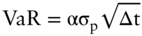
where:
 |
is the standard deviation of the portfolio market risk, which we will revisit later; |
| represents the weight assigned to the ... |
Read now
Unlock full access


 O’Reilly covers everything we've got, with content to help us build a world-class technology community, upgrade the capabilities and competencies of our teams, and improve overall team performance as well as their engagement.I wanted to learn C and C++, but it didn't click for me until I picked up an O'Reilly book. When I went on the O’Reilly platform, I was astonished to find all the books there, plus live events and sandboxes so you could play around with the technology.I’ve been on the O’Reilly platform for more than eight years. I use a couple of learning platforms, but I'm on O'Reilly more than anybody else. When you're there, you start learning. I'm never disappointed.I'm always learning. So when I got on to O'Reilly, I was like a kid in a candy store. There are playlists. There are answers. There's on-demand training. It's worth its weight in gold, in terms of what it allows me to do.