March 2026
Intermediate to advanced
208 pages
6h 28m
English
In 2009, Google launched Wave (see Figure 2-1), a novel communication and collaboration platform that promised to reinvent how people work together online. It combined the features of email, instant messaging, and document editing into a single place, acting as a one-stop shop for communication and creation.
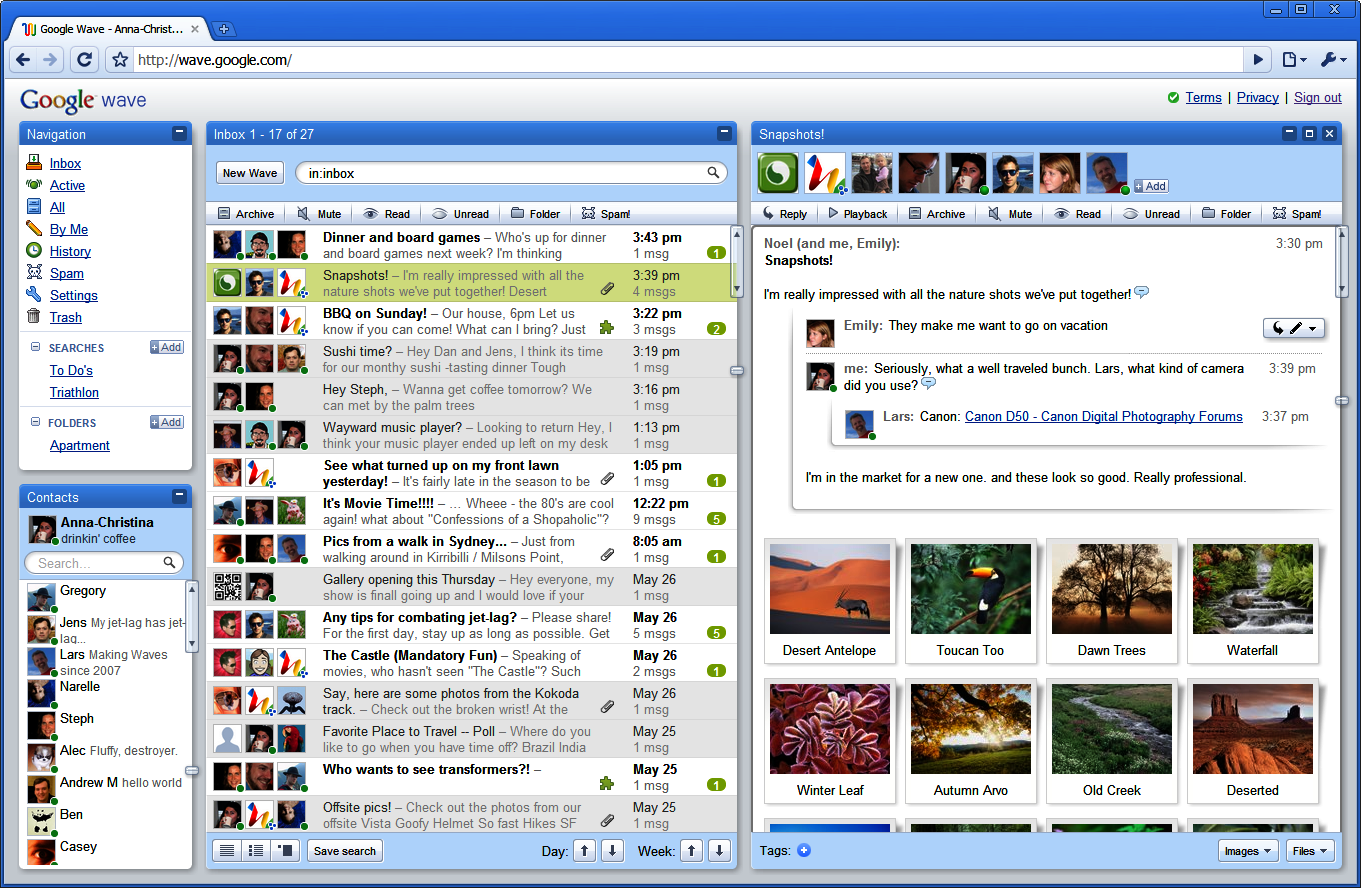
Unfortunately, it died an early death. Google would soon cancel work on Wave, because, as the Museum of Failure puts it, “the service was too ambitious, hard to learn, and barely an improvement over regular email.”
Wave took its name from Firefly, the sci-fi series where sending a wave meant transmitting a message across time and distance. Google’s version aimed to modernize communication in the same spirit: waves were real-time, shared documents that supported rich media, inline replies, and simultaneous editing by multiple participants. Built on a hosted XML structure, each wave functioned as a live thread that blended messaging with collaborative content creation. Users could drop in images, maps, or files, edit each other’s contributions midstream, and extend functionality through bots and gadgets.
At launch, the product drew enormous interest. But despite the excitement, many users struggled to understand what Wave was for. The promise of a unified workspace was clear in theory, but in ...
Read now
Unlock full access


 O’Reilly covers everything we've got, with content to help us build a world-class technology community, upgrade the capabilities and competencies of our teams, and improve overall team performance as well as their engagement.I wanted to learn C and C++, but it didn't click for me until I picked up an O'Reilly book. When I went on the O’Reilly platform, I was astonished to find all the books there, plus live events and sandboxes so you could play around with the technology.I’ve been on the O’Reilly platform for more than eight years. I use a couple of learning platforms, but I'm on O'Reilly more than anybody else. When you're there, you start learning. I'm never disappointed.I'm always learning. So when I got on to O'Reilly, I was like a kid in a candy store. There are playlists. There are answers. There's on-demand training. It's worth its weight in gold, in terms of what it allows me to do.