March 2017
Beginner to intermediate
370 pages
9h 55m
English
NOW THAT YOU HAVE THE BASICS DOWN, it’s time to put them into action beginning in this chapter. Using the framework introduced in Chapter 3, we’ll begin to flesh out each step in the process of designing an A/B test, and explain how the early and close involvement of designers is necessary to your team’s success. We’ll be discussing the activities shown in Figure 4-1 that are outlined in a dotted line. Throughout, we’ll revisit some of the common themes we highlighted in the Preface and Chapter 1.
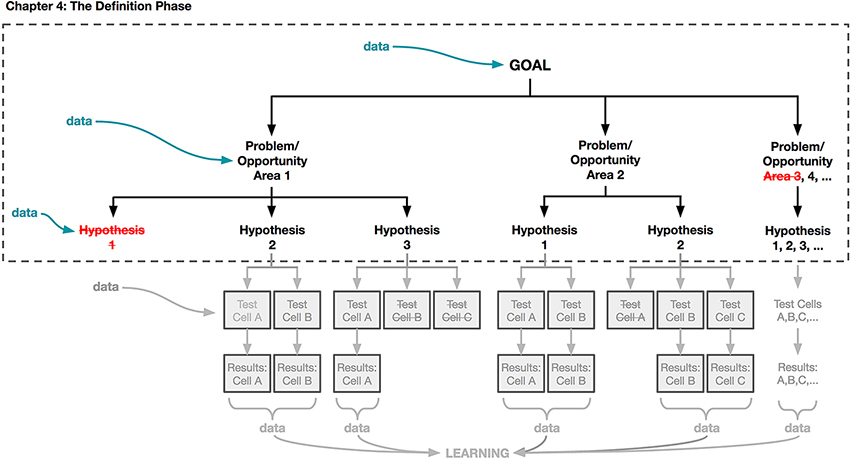
Taking a data-aware approach to design requires approaching your work with an open-minded attitude toward learning as much as you can about your users and which designs resonate with them. Adopting an approach of experimentation, and using data to explore and evaluate your ideas, will make you a better designer overall.
We’re going to spend the bulk of this chapter laying out how you can define your goals, problems, and hypotheses to maximize your learning when designing with data. Recall that a hypothesis is a statement that captures the impact you believe your design will have on your users. In this chapter, we’ll show you how to craft a strong hypothesis and ...
Read now
Unlock full access


 O’Reilly covers everything we've got, with content to help us build a world-class technology community, upgrade the capabilities and competencies of our teams, and improve overall team performance as well as their engagement.I wanted to learn C and C++, but it didn't click for me until I picked up an O'Reilly book. When I went on the O’Reilly platform, I was astonished to find all the books there, plus live events and sandboxes so you could play around with the technology.I’ve been on the O’Reilly platform for more than eight years. I use a couple of learning platforms, but I'm on O'Reilly more than anybody else. When you're there, you start learning. I'm never disappointed.I'm always learning. So when I got on to O'Reilly, I was like a kid in a candy store. There are playlists. There are answers. There's on-demand training. It's worth its weight in gold, in terms of what it allows me to do.