November 2018
Intermediate to advanced
296 pages
11h 3m
English
We have learned a great deal so far about what fluorescent nanodiamonds (FNDs) can do, for example, from detecting a single biomolecule (Chapter 7) to imaging a whole organism (Chapter 9). Now the question is how. How to make all these wonders of science? Specifically, in a tiny world of nanoparticles, what tools are necessary to study FNDs? What do we have to know in order to make the best use of these tools?
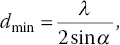
To “see” FNDs in action, researchers have been relying on fluorescence microscopy, which has made profound advance throughout past decades in enhancing our understanding of molecular and cellular biology. As powerful as it is, however, fluorescence microscopy is limited by the diffraction of light to elucidate detailed structure of the organelles in cells. Considering a microscopic object to consist of diffraction gratings, Ernst Abbe concluded in 1873 that the resolution limit of a microscope is one half the wavelength of the light used for illumination [1],
where dmin is the minimum resolvable distance, λ is the wavelength of the light, and α is the half aperture angle of the microscope’s objective [2]. For green light of 532 nm in wavelength as an example, the Abbe limit is dmin = λ/2 = 266 nm (or 0.266 μm), which is small compared to most biological cells (~10 μm), but large compared to viruses (~100 nm), proteins (~5 nm), and small biomolecules ...
Read now
Unlock full access


 O’Reilly covers everything we've got, with content to help us build a world-class technology community, upgrade the capabilities and competencies of our teams, and improve overall team performance as well as their engagement.I wanted to learn C and C++, but it didn't click for me until I picked up an O'Reilly book. When I went on the O’Reilly platform, I was astonished to find all the books there, plus live events and sandboxes so you could play around with the technology.I’ve been on the O’Reilly platform for more than eight years. I use a couple of learning platforms, but I'm on O'Reilly more than anybody else. When you're there, you start learning. I'm never disappointed.I'm always learning. So when I got on to O'Reilly, I was like a kid in a candy store. There are playlists. There are answers. There's on-demand training. It's worth its weight in gold, in terms of what it allows me to do.