June 2004
Beginner
1328 pages
75h 52m
English

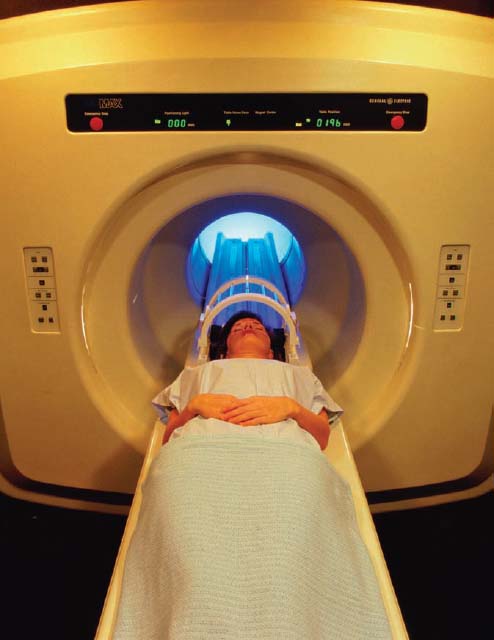
During an MRI (magnetic resonance imaging) scan, a patient is placed in an apparatus in which there is a large steady magnetic field and a small sinusoidally varying magnetic field. This medical procedure has been performed countless times without harm to patients. Indeed, a magnetic field should not be harmful. In a few cases, however, the patient has been burned during a scan because the operating staff made a simple error about the physics of the arrangement.
How can a magnetic field cause burns?
The answer is in this chapter.
In Chapter 29 we discussed the fact that a current produces a magnetic field. That fact came as a surprise to the scientists who discovered the effect. Perhaps even more surprising was the discovery of the reverse effect: A magnetic field can produce an electric field that can drive a current. This link between a magnetic field and the electric field it produces (induces) is now called Faraday’s law of induction.
The observations by Michael Faraday and other scientists that led to this law were at first just basic science, interesting in that they revealed another facet of how our universe works. Today, however, applications of that basic science are almost everywhere. For example, induction is the basis of the electric guitars that ...
Read now
Unlock full access


 O’Reilly covers everything we've got, with content to help us build a world-class technology community, upgrade the capabilities and competencies of our teams, and improve overall team performance as well as their engagement.I wanted to learn C and C++, but it didn't click for me until I picked up an O'Reilly book. When I went on the O’Reilly platform, I was astonished to find all the books there, plus live events and sandboxes so you could play around with the technology.I’ve been on the O’Reilly platform for more than eight years. I use a couple of learning platforms, but I'm on O'Reilly more than anybody else. When you're there, you start learning. I'm never disappointed.I'm always learning. So when I got on to O'Reilly, I was like a kid in a candy store. There are playlists. There are answers. There's on-demand training. It's worth its weight in gold, in terms of what it allows me to do.