March 2025
Intermediate to advanced
546 pages
14h 40m
English
The layered architecture style, also known as n-tiered, is one of the most common architecture styles. It’s the de facto standard for many legacy applications because of its simplicity, familiarity, and low cost.
The layered architecture style can fall into several architectural antipatterns, including the Architecture by Implication and the Accidental Architecture antipatterns. When developers or architects “just start coding,” unsure which architecture style they are using, chances are good that they’re implementing the layered architecture style.
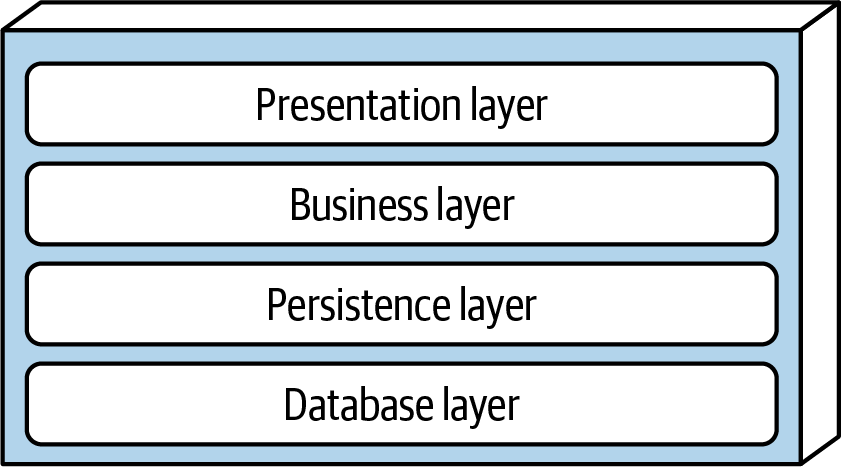
Components within the layered architecture style are organized into logical horizontal layers, as shown in Figure 10-1, with each layer performing a specific role within the application (such as presentation logic or business logic). Although there are no specific restrictions in terms of the number and types of layers that must exist, most layered architectures consist of four standard layers: Presentation, Business, Persistence, and Database. Some architectures combine the Business and Persistence layers, particularly when the persistence logic (such as SQL or HSQL) is embedded within the Business layer components. Smaller applications may have only three layers, whereas larger and more complex business applications may contain five or more.
Read now
Unlock full access


 O’Reilly covers everything we've got, with content to help us build a world-class technology community, upgrade the capabilities and competencies of our teams, and improve overall team performance as well as their engagement.I wanted to learn C and C++, but it didn't click for me until I picked up an O'Reilly book. When I went on the O’Reilly platform, I was astonished to find all the books there, plus live events and sandboxes so you could play around with the technology.I’ve been on the O’Reilly platform for more than eight years. I use a couple of learning platforms, but I'm on O'Reilly more than anybody else. When you're there, you start learning. I'm never disappointed.I'm always learning. So when I got on to O'Reilly, I was like a kid in a candy store. There are playlists. There are answers. There's on-demand training. It's worth its weight in gold, in terms of what it allows me to do.