November 2019
Beginner to intermediate
267 pages
5h 47m
English
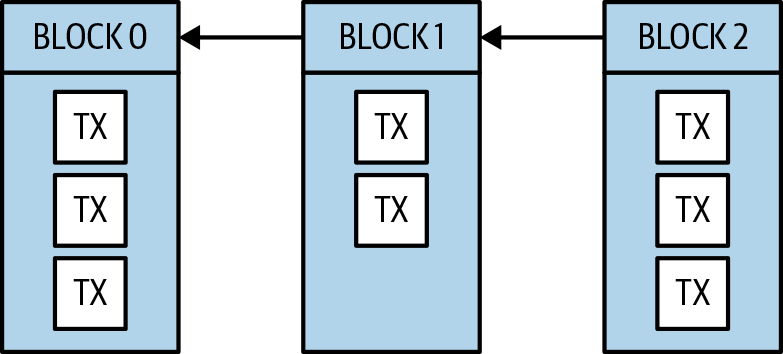
Fundamentally, a blockchain is a data structure. It is a linked list, or chain, of unique “blocks.” Each block points to the previous one, and is itself a list of transactions. On top of this relatively simple list-of-lists data structure is laid the key innovation that blockchains have given us: a protocol for how blocks are added to the chain without any central authority. Figure 1-1 illustrates this structure.
The cryptocurrencies that have come along with blockchains are a means to an end, providing incentives for people to run software that secures the network. For the first time in history, we have the ability to share digital information without trusting any person, government, organization, or corporation to facilitate the interaction. Ethereum provides a cryptographically secure platform for storing, updating, and removing data from a blockchain using what is referred to as “smart contracts.” We are still in the early days of learning how to use smart contracts to improve things in the real world, and it’s hard to predict how the technology will be used in the future. Similar to the “World Wide Web” in the 1990s, there has been a global influx of inspiring and creative problem-solvers who are working every day to deploy decentralized applications (DApps) that they hope will “make a dent in the universe.”
Read now
Unlock full access


 O’Reilly covers everything we've got, with content to help us build a world-class technology community, upgrade the capabilities and competencies of our teams, and improve overall team performance as well as their engagement.I wanted to learn C and C++, but it didn't click for me until I picked up an O'Reilly book. When I went on the O’Reilly platform, I was astonished to find all the books there, plus live events and sandboxes so you could play around with the technology.I’ve been on the O’Reilly platform for more than eight years. I use a couple of learning platforms, but I'm on O'Reilly more than anybody else. When you're there, you start learning. I'm never disappointed.I'm always learning. So when I got on to O'Reilly, I was like a kid in a candy store. There are playlists. There are answers. There's on-demand training. It's worth its weight in gold, in terms of what it allows me to do.