April 2019
Beginner
556 pages
14h 21m
English

It’s time to get organized. So far, we’ve been throwing all our code together in a single file. As our programs grow bigger and more complex, that’s going to quickly become a mess.
In this chapter, we’ll show you how to create your own packages to help keep related code together in one place. But packages are good for more than just organization. Packages are an easy way to share code between your programs. And they’re an easy way to share code with other developers.
We’ve written two programs, each with an identical copy of a function, and it’s becoming a maintenance headache...
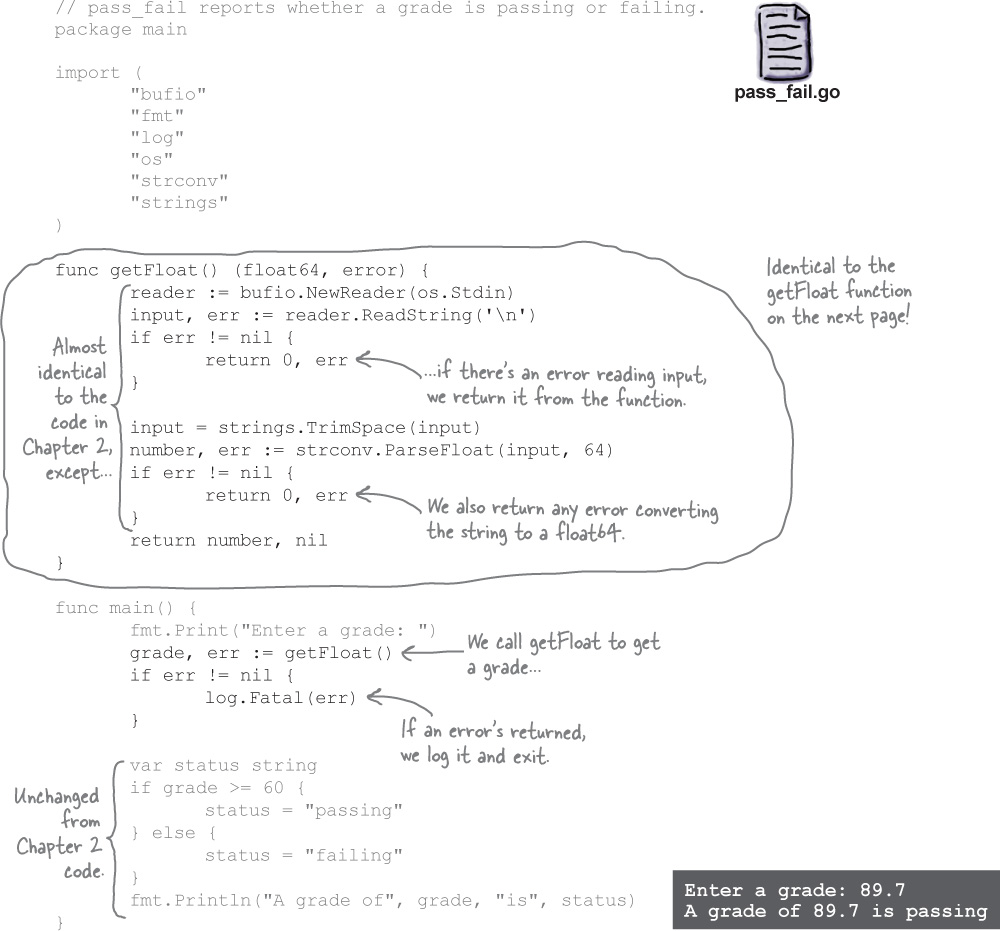
On this page, we’ve got a new version of our pass_fail.go program from Chapter 2. The code that reads a grade from the keyboard has been moved to a new getFloat function. getFloat returns the floating-point number the user typed, unless there’s an error, in which case it returns 0 and an error value. If an error is returned, the program reports it and exits; otherwise, it reports whether the grade is passing or failing, as before.
On this page, we’ve got a new tocelsius.go program that lets the user type a temperature in the Fahrenheit measurement system and converts it to the Celsius system.
Notice that the getFloat function ...
Read now
Unlock full access


 O’Reilly covers everything we've got, with content to help us build a world-class technology community, upgrade the capabilities and competencies of our teams, and improve overall team performance as well as their engagement.I wanted to learn C and C++, but it didn't click for me until I picked up an O'Reilly book. When I went on the O’Reilly platform, I was astonished to find all the books there, plus live events and sandboxes so you could play around with the technology.I’ve been on the O’Reilly platform for more than eight years. I use a couple of learning platforms, but I'm on O'Reilly more than anybody else. When you're there, you start learning. I'm never disappointed.I'm always learning. So when I got on to O'Reilly, I was like a kid in a candy store. There are playlists. There are answers. There's on-demand training. It's worth its weight in gold, in terms of what it allows me to do.