May 2022
Beginner
754 pages
21h 51m
English

Java takes you to new places. From its humble release to the public as the (wimpy) version 1.02, Java seduced programmers with its friendly syntax, object-oriented features, memory management, and best of all—the promise of portability. The lure of write-once/run-anywhere is just too strong. A devoted following exploded, as programmers fought against bugs, limitations, and, oh yeah, the fact that it was dog slow. But that was ages ago. If you’re just starting in Java, you’re lucky. Some of us had to walk five miles in the snow, uphill both ways (barefoot), to get even the most trivial application to work. But you, why, you get to ride the sleeker, faster, easier-to-read-and-write Java of today.
The goal is to write one application (in this example, an interactive party invitation) and have it work on whatever device your friends have.

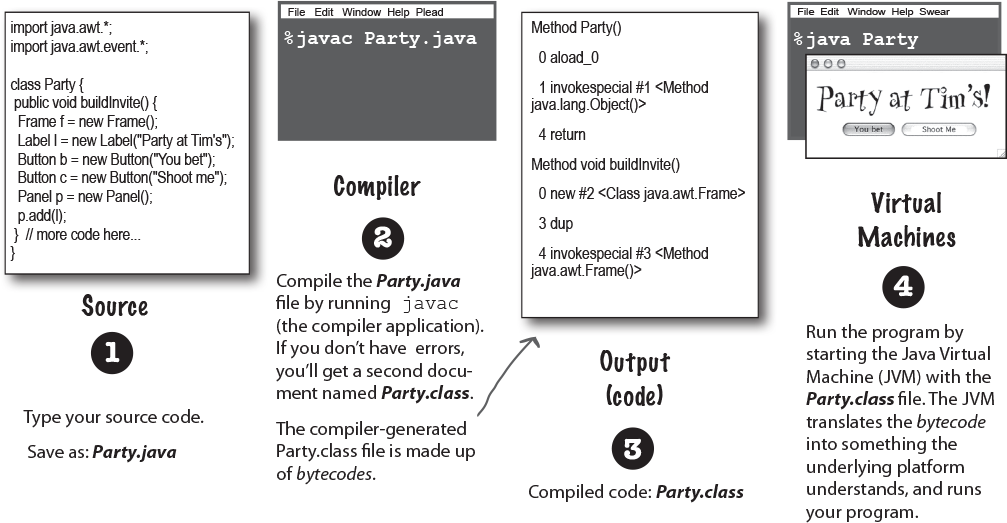
You’ll type a source code file, compile it using the javac compiler, and then run the compiled bytecode on a Java virtual machine.
(Note: this is NOT meant to be a tutorial... you’ll be writing real code in a moment, but for now, we just ...