September 2001
Intermediate to advanced
528 pages
13h 46m
English
Now that the options for web tier development have been examined, let’s look at how the web tier interacts with other tiers in large enterprise class systems. A typical EJB architecture involves a thin browser client, a servlet-driven web tier, and EJB on an application server tier. Figure 4-7 expands upon the conceptual XSLT model presented earlier.
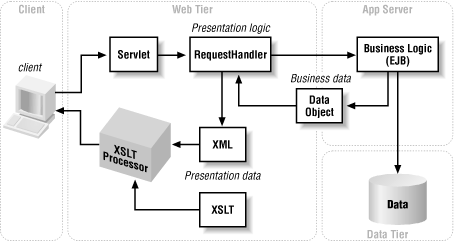
Figure 4-7. XSLT and EJB architecture
This diagram is much closer to the true physical model of a multitier
web application that uses XSLT. The arrows indicate the overall flow
of a single request, originating with the client. This client is
typically a web browser, but it could be a cell phone or some other
device. The client request goes to a single servlet and is handed off
to something called
RequestHandler
.
In the pattern outlined here, you create numerous subclasses of
RequestHandler. Each subclass is responsible for
validation and presentation logic for a small set of related
functions. One manageable strategy is to design one subclass of
RequestHandler for each web page in the
application. Another approach is to create fine-grained request
handlers that handle one specific task, which can be beneficial if
the same piece of functionality is invoked from many different
screens in your application.
The request handler interacts with the application server via EJB components. The normal pattern is to execute commands ...
Read now
Unlock full access


 O’Reilly covers everything we've got, with content to help us build a world-class technology community, upgrade the capabilities and competencies of our teams, and improve overall team performance as well as their engagement.I wanted to learn C and C++, but it didn't click for me until I picked up an O'Reilly book. When I went on the O’Reilly platform, I was astonished to find all the books there, plus live events and sandboxes so you could play around with the technology.I’ve been on the O’Reilly platform for more than eight years. I use a couple of learning platforms, but I'm on O'Reilly more than anybody else. When you're there, you start learning. I'm never disappointed.I'm always learning. So when I got on to O'Reilly, I was like a kid in a candy store. There are playlists. There are answers. There's on-demand training. It's worth its weight in gold, in terms of what it allows me to do.