August 2024
Intermediate to advanced
256 pages
5h 12m
English
ONE THING THAT most people don't know about me is that I received a teaching degree from the University of Toledo. I did not end up choosing the path of the traditional grade school teacher and coach. But learning and teaching has been in my professional DNA, when I started teaching tennis to kids when I was 16 years old, and before that, instructing my paper route part-time employees when I was 12.
It has been a journey of continuous learning and hyper-learning with fellow professional athletes early in my professional career, to the top 3% of business owners globally, and from the Entrepreneurs' Organization.
From the time I left university, I was submerged in two valuable lessons on learning. First, if I was unable to learn fast, I would never survive in professional baseball. Because the learning is at such a high intensity, you are being trained to learn in a very kinesthetic way. This is one of the three learning styles: auditory (humans have been learning this way for millennia), visual (our main style of learning in our schools), and kinesthetic (see Figure 13.1). Kinesthetic learning is an active way of learning through discussions, physical practice, and then the opportunity to teach others the skills we have learned (highest levels of retention rate).
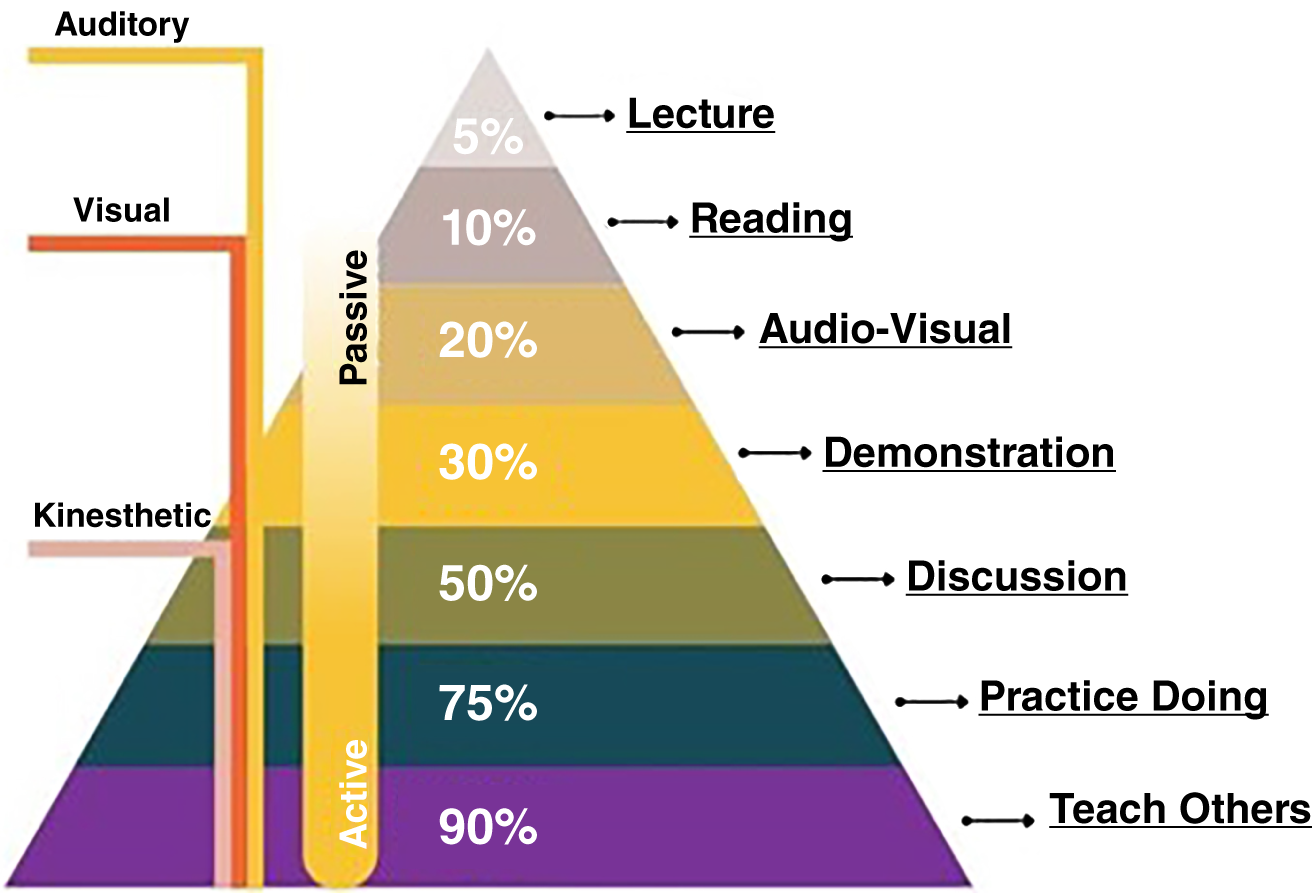
Figure 13.1 The Learning Retention ...
Read now
Unlock full access


 O’Reilly covers everything we've got, with content to help us build a world-class technology community, upgrade the capabilities and competencies of our teams, and improve overall team performance as well as their engagement.I wanted to learn C and C++, but it didn't click for me until I picked up an O'Reilly book. When I went on the O’Reilly platform, I was astonished to find all the books there, plus live events and sandboxes so you could play around with the technology.I’ve been on the O’Reilly platform for more than eight years. I use a couple of learning platforms, but I'm on O'Reilly more than anybody else. When you're there, you start learning. I'm never disappointed.I'm always learning. So when I got on to O'Reilly, I was like a kid in a candy store. There are playlists. There are answers. There's on-demand training. It's worth its weight in gold, in terms of what it allows me to do.