June 2025
Intermediate to advanced
576 pages
11h 26m
English
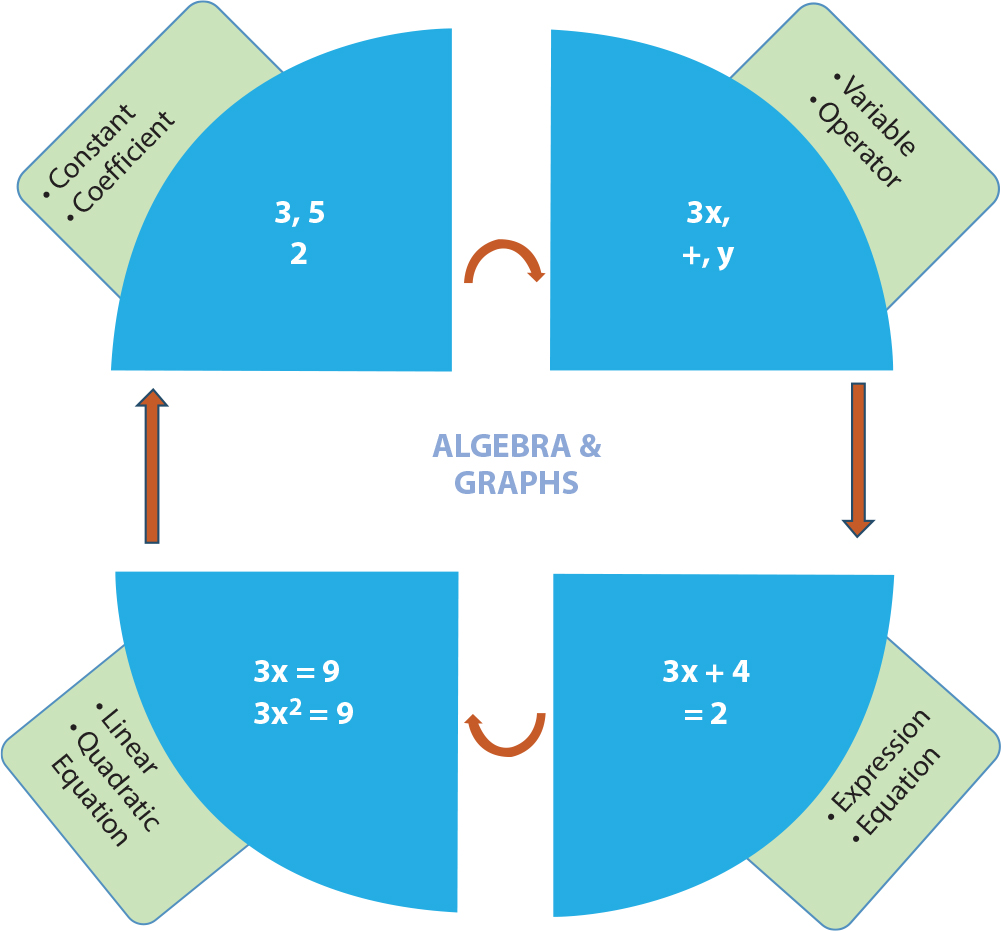
Objectives: This chapter
“Algebra” is derived from the Arabic word written in the treatise of Medieval Persian Mathematician. The treatise provides a primary root of algebra and a systematic meaningful solution for the linear and quadratic equations. The late Middle English algebra style has come from Italian, Spanish, and medieval Latin, rooted in Arabic words.
The ancient Babylonians invented formulas to resolve linear, quadratic, and indeterminate linear equations, which are the origins of algebra. Chinese, Greek, and Egyptian math used geometric techniques to determine these equations. Algebra was first developed as a branch of mathematics distinct from geometry and arithmetic by the Iranian mathematician Muammadibn.
The traditions of Egypt and Babylon were carried on by Hellenistic mathematicians such as Diophantus and Indian mathematician Brahmagupta (Brahmasphutasiddhanta, published in 628 AD), but on a higher level that incorporates zero or negative integers.
A debate about the entitlement of “the father of algebra” exists between the Greek mathematician Diophantus & Persian ...
Read now
Unlock full access


 O’Reilly covers everything we've got, with content to help us build a world-class technology community, upgrade the capabilities and competencies of our teams, and improve overall team performance as well as their engagement.I wanted to learn C and C++, but it didn't click for me until I picked up an O'Reilly book. When I went on the O’Reilly platform, I was astonished to find all the books there, plus live events and sandboxes so you could play around with the technology.I’ve been on the O’Reilly platform for more than eight years. I use a couple of learning platforms, but I'm on O'Reilly more than anybody else. When you're there, you start learning. I'm never disappointed.I'm always learning. So when I got on to O'Reilly, I was like a kid in a candy store. There are playlists. There are answers. There's on-demand training. It's worth its weight in gold, in terms of what it allows me to do.