June 2025
Intermediate to advanced
576 pages
11h 26m
English

Objectives: This chapter
Calculus—“The mathematics of change”
Calculus is one of the most important discoveries in modern mathematics; questions that were difficult to answer by great mathematicians, scientists, and philosophers for more than two thousand years were solved with the help of Calculus. It is just very advanced algebra and geometry. In one sense, it takes the ordinary rules of algebra and geometry and reforms them to be used on more complicated problems.
The use of Calculus is everywhere, mainly in every branch of science and engineering, business, medicine, etc. The fundamental idea of Calculus is to study change by studying “Instantaneous Change,” which means changes over a short time.
Let’s understand how Calculus is different from simple mathematics. Look at the figure below.
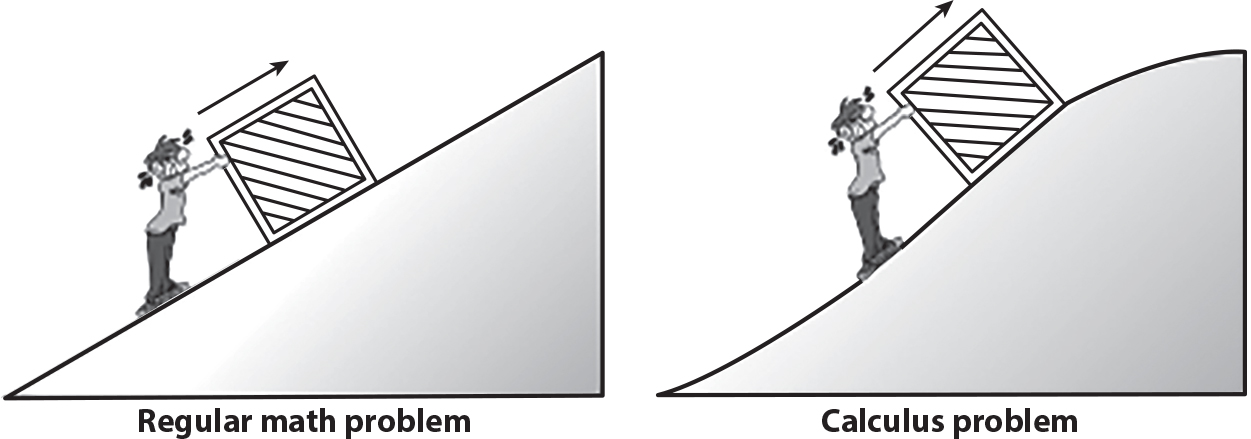
In Figure, Sameer pushes with a constant force for the straight slope, and the crate goes up the slope at a constant speed. With some regular math and simple physics formulas (including algebra and trigonometry), we can calculate the number of calories of energy ...
Read now
Unlock full access


 O’Reilly covers everything we've got, with content to help us build a world-class technology community, upgrade the capabilities and competencies of our teams, and improve overall team performance as well as their engagement.I wanted to learn C and C++, but it didn't click for me until I picked up an O'Reilly book. When I went on the O’Reilly platform, I was astonished to find all the books there, plus live events and sandboxes so you could play around with the technology.I’ve been on the O’Reilly platform for more than eight years. I use a couple of learning platforms, but I'm on O'Reilly more than anybody else. When you're there, you start learning. I'm never disappointed.I'm always learning. So when I got on to O'Reilly, I was like a kid in a candy store. There are playlists. There are answers. There's on-demand training. It's worth its weight in gold, in terms of what it allows me to do.