December 2016
Beginner
494 pages
12h 34m
English
Application frameworks interpret and execute code written in languages such as Java, PHP, Python, and Ruby. Frameworks can be bundled within larger web server packages (e.g., ASP.NET within Microsoft IIS) or run using distinct application and web server components (such as JBoss Application Server running atop of Apache Tomcat). Figure 14-1 demonstrates popular application and web server configurations (note: many of these frameworks can also be presented using alternate web servers).
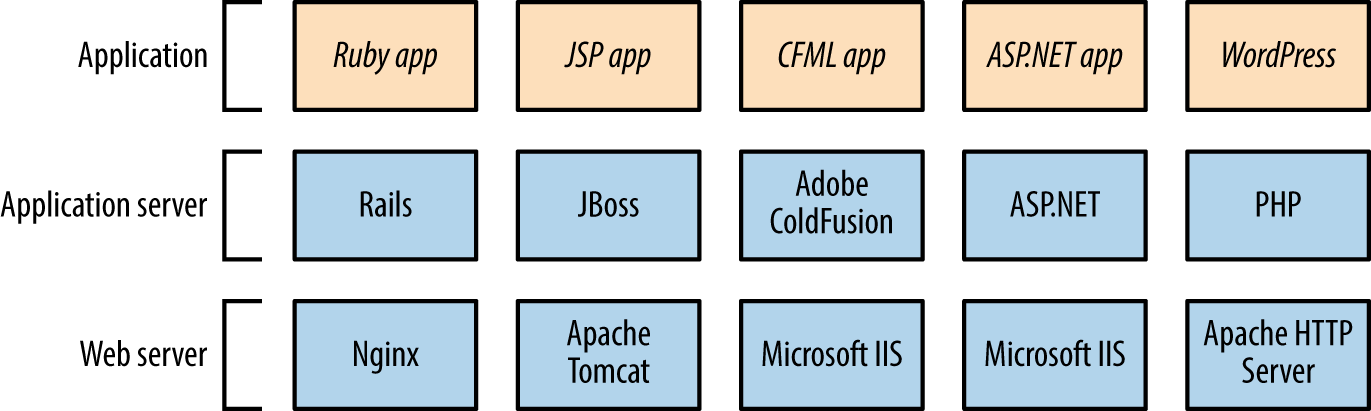
In many cases, developers are responsible for application security, and IT operations staff infrastructure security. Exploitable gaps might exist if parties neglect to harden the framework components between these layers.
This chapter describes application framework investigation and exploitation.
Chapter 13 describes application framework fingerprinting through the following:
Review of HTTP headers (e.g., Server and X-Powered-By)
Analysis of cookies set upon connecting (primarily session variables)
Analysis of filenames, extensions, and directory structures
Review of metadata within content (e.g., HTML and JavaScript)
Automated tools that you can use to further investigate and profile application framework components include BlindElephant,1 WAFP, ...
Read now
Unlock full access


 O’Reilly covers everything we've got, with content to help us build a world-class technology community, upgrade the capabilities and competencies of our teams, and improve overall team performance as well as their engagement.I wanted to learn C and C++, but it didn't click for me until I picked up an O'Reilly book. When I went on the O’Reilly platform, I was astonished to find all the books there, plus live events and sandboxes so you could play around with the technology.I’ve been on the O’Reilly platform for more than eight years. I use a couple of learning platforms, but I'm on O'Reilly more than anybody else. When you're there, you start learning. I'm never disappointed.I'm always learning. So when I got on to O'Reilly, I was like a kid in a candy store. There are playlists. There are answers. There's on-demand training. It's worth its weight in gold, in terms of what it allows me to do.