November 2025
Intermediate to advanced
352 pages
12h 30m
English
Jitter in imaging satellites and laser systems refers to the small, rapid, and often unintended variations or fluctuations in the pointing direction or alignment of the satellite or laser beam. In imaging satellites, jitter can degrade the quality of captured images by causing blurring or distortion, especially in high-resolution imaging where precise pointing is critical. In laser systems, jitter can affect the accuracy and effectiveness of laser targeting or communication by causing the laser beam to wander off-target. For high performance imaging and laser systems, jitter requirements are very tight and significant effort is spent in design to meet these performance requirements.
Figure 5.1 shows where the line-of-sight (LOS) pointing as a function of time is shown in the left graph. The right picture compares the images taken when significant micro-vibration perturbations were present, when some corrective measures had been applied afterward, and when the imager LOS was undisturbed during the picture-taking.
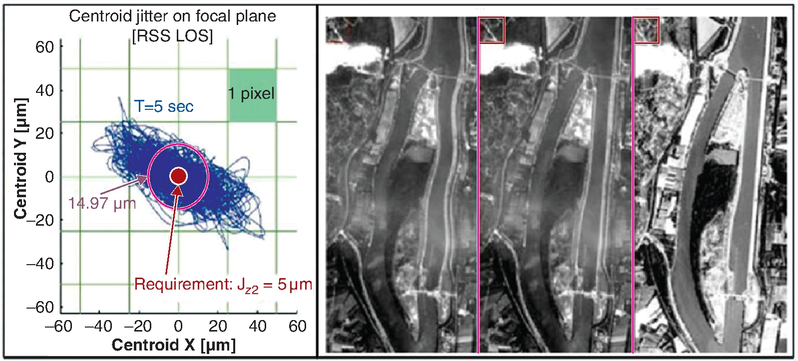
Figure 5.1 Example of LOS pointing errors and the resulting effects on image quality.
Source: NASA/Public Domain.
As seen in Figure 5.1, the pixel size in focal plane of the imaging satellite is 25 × 25 µm2. The allowable motion is 5 µm, one-fifth of the pixel size. As will be shown in Chapter 7, this ...
Read now
Unlock full access


 O’Reilly covers everything we've got, with content to help us build a world-class technology community, upgrade the capabilities and competencies of our teams, and improve overall team performance as well as their engagement.I wanted to learn C and C++, but it didn't click for me until I picked up an O'Reilly book. When I went on the O’Reilly platform, I was astonished to find all the books there, plus live events and sandboxes so you could play around with the technology.I’ve been on the O’Reilly platform for more than eight years. I use a couple of learning platforms, but I'm on O'Reilly more than anybody else. When you're there, you start learning. I'm never disappointed.I'm always learning. So when I got on to O'Reilly, I was like a kid in a candy store. There are playlists. There are answers. There's on-demand training. It's worth its weight in gold, in terms of what it allows me to do.