April 2022
Intermediate to advanced
384 pages
11h 28m
English
Resonators play an important role in superconducting quantum computers. The qubits themselves are nonlinear resonators, and in many architectures, the qubits are coupled to other qubits and to external circuits through transmission line segments functioning as resonators. In quantum computers these resonators are excited with small numbers of photons, and so must ultimately be analyzed quantum mechanically. However, it is helpful to gain intuition about the behavior of both lumped circuits and transmission line resonators using classical analysis. Consequently we will focus on a classical treatment in this chapter, and then consider a quantum mechanical treatment in Chapter 6.
Consider the lumped-element circuit shown in Figure 5.1(a) consisting of a capacitor, inductor, and resistor in parallel.

The impedance Zin of the circuit is given by:
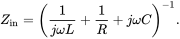 (5.1)
(5.1)For large R, the impedance will be sharply peaked around . Consequently, let us expand the impedance about ω0, i.e., :
 (5.2)
(5.2)The first term can be re-written using the series expansion for small x
where :
This expression can be ...
Read now
Unlock full access


 O’Reilly covers everything we've got, with content to help us build a world-class technology community, upgrade the capabilities and competencies of our teams, and improve overall team performance as well as their engagement.I wanted to learn C and C++, but it didn't click for me until I picked up an O'Reilly book. When I went on the O’Reilly platform, I was astonished to find all the books there, plus live events and sandboxes so you could play around with the technology.I’ve been on the O’Reilly platform for more than eight years. I use a couple of learning platforms, but I'm on O'Reilly more than anybody else. When you're there, you start learning. I'm never disappointed.I'm always learning. So when I got on to O'Reilly, I was like a kid in a candy store. There are playlists. There are answers. There's on-demand training. It's worth its weight in gold, in terms of what it allows me to do.