August 2009
Intermediate to advanced
281 pages
6h 50m
English
Because of the extreme flexibility that the application will demonstrate, this next section works with a more complex set of relationships. In addition to these relationships, interfaces need to be created to add, edit, and delete any of those objects. Another interface needs to be created to adapt a set of contacts from Outlook into new contacts in this system. Finally, users need to be able to view the contacts that they own.
This contact administration is broken up into the following steps:
Working with contacts and information
Contact information relationships
Importing contacts
Viewing contacts
The root of the contacts interaction is the ContactsModule. I'm going to start by defining this module (Figure 21-12).
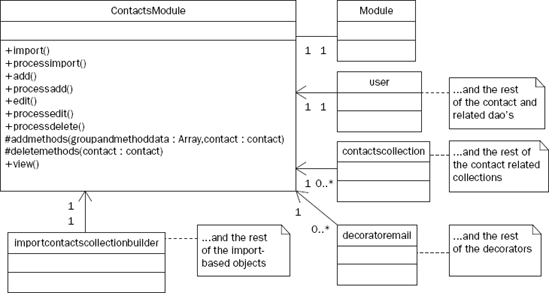
Predictably, the ContactsModule is an instance of a Module object. It has eight public methods. Displaying and processing additions, edits, and deletions are represented. Methods for accepting and processing the contacts to be imported are also defined. Finally, the view() method will be used to show an individual contact. There are two protected methods, addmethods() and deletemethods().
addmethods() will accept two parameters. One will be the current Contact that the application is adding methods to. The other will be an array of group and method information. ...
Read now
Unlock full access


 O’Reilly covers everything we've got, with content to help us build a world-class technology community, upgrade the capabilities and competencies of our teams, and improve overall team performance as well as their engagement.I wanted to learn C and C++, but it didn't click for me until I picked up an O'Reilly book. When I went on the O’Reilly platform, I was astonished to find all the books there, plus live events and sandboxes so you could play around with the technology.I’ve been on the O’Reilly platform for more than eight years. I use a couple of learning platforms, but I'm on O'Reilly more than anybody else. When you're there, you start learning. I'm never disappointed.I'm always learning. So when I got on to O'Reilly, I was like a kid in a candy store. There are playlists. There are answers. There's on-demand training. It's worth its weight in gold, in terms of what it allows me to do.