August 2009
Intermediate to advanced
281 pages
6h 50m
English
The steps to becoming a great programmer revolve around the core of the application:
You program procedurally using a collection of includes.
Next you build your own framework to use as a base for your next project.
You then abandon your framework and leveraging existing proven frameworks in your project.
Normally, I move forward using what I've learned by getting to step 3 and would recommend one of the frameworks mentioned in Chapter 2. However, because I'm trying to demonstrate the usage of Design Patterns from an initial planning perspective, I am opting to create a very simple framework. While existing frameworks would jumpstart this application, the code is already written by someone else. I can only make guesses as to the thought processes of the original programmers.
A type of architecture I favor is Model-View-Controller, or MVC. To begin the core of the application, I'm going to build three objects, a controller, a module (or model), and a view object.
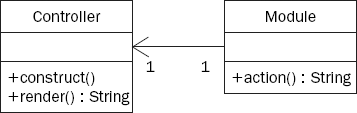
The Controller object (Figure 21-1) will be responsible for determining what type of action the application is trying to accomplish from the web request. It has two public methods, __construct() and render(). __construct() will be responsible for making sense of the web request. It will also process any posted information. render() will be responsible for executing the proper ...
Read now
Unlock full access


 O’Reilly covers everything we've got, with content to help us build a world-class technology community, upgrade the capabilities and competencies of our teams, and improve overall team performance as well as their engagement.I wanted to learn C and C++, but it didn't click for me until I picked up an O'Reilly book. When I went on the O’Reilly platform, I was astonished to find all the books there, plus live events and sandboxes so you could play around with the technology.I’ve been on the O’Reilly platform for more than eight years. I use a couple of learning platforms, but I'm on O'Reilly more than anybody else. When you're there, you start learning. I'm never disappointed.I'm always learning. So when I got on to O'Reilly, I was like a kid in a candy store. There are playlists. There are answers. There's on-demand training. It's worth its weight in gold, in terms of what it allows me to do.