August 2019
Intermediate to advanced
392 pages
14h 11m
English
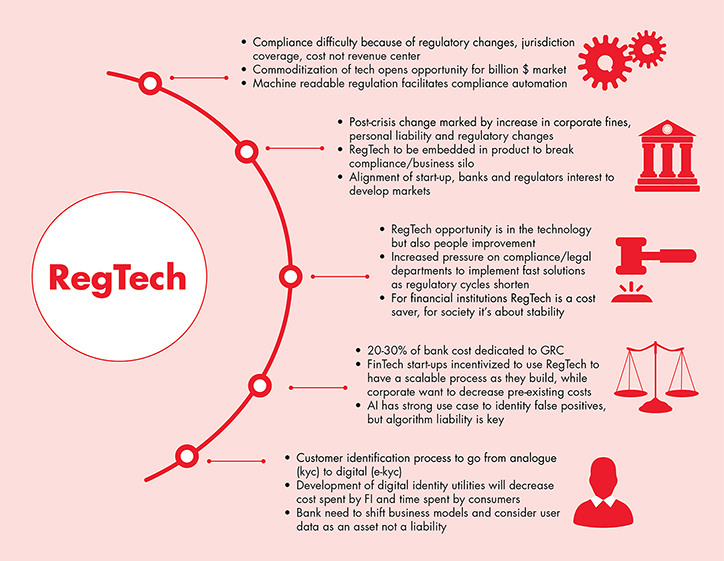
This part sets out to provide an overview of the RegTech sector and its development.
By contextualizing the origin of the industry’s growth generated by the post-financial crisis increase in fines and the acceleration of new regulation and personal liability, the following chapters highlight the opportunities RegTech offers. It is important to differentiate the RegTech opportunities as a market reform as opposed to a market reaction, to which FinTech is more akin. In addition, as will be elaborated upon in Part 9, RegTech applicability expands beyond the financial services industry. As a direct related matter, the US$20 billion in spending predicted to occur by 2020 is only for one industry.
The automation of regulatory obligations represents a transition from People, Process, Paper (3P) towards Automation, Real-Time, and Predictive (AIR). The obvious impact is in the decrease of compliance costs for financial institutions but also the improvement of the market supervision role for regulators and even customer experience for clients. A less immediate impact is that a well-implemented RegTech strategy can enable the multi-million-dollar digital transformation efforts being initiated by financial institutions globally.
As an industry in general, financial institutions perceive RegTech providers as cost-cutting options, with some systems benefiting from consortiums ...
Read now
Unlock full access


 O’Reilly covers everything we've got, with content to help us build a world-class technology community, upgrade the capabilities and competencies of our teams, and improve overall team performance as well as their engagement.I wanted to learn C and C++, but it didn't click for me until I picked up an O'Reilly book. When I went on the O’Reilly platform, I was astonished to find all the books there, plus live events and sandboxes so you could play around with the technology.I’ve been on the O’Reilly platform for more than eight years. I use a couple of learning platforms, but I'm on O'Reilly more than anybody else. When you're there, you start learning. I'm never disappointed.I'm always learning. So when I got on to O'Reilly, I was like a kid in a candy store. There are playlists. There are answers. There's on-demand training. It's worth its weight in gold, in terms of what it allows me to do.