January 2019
Intermediate to advanced
616 pages
25h 14m
English
Armen Sarvazyan1 and Matthew W. Urban2
1 Artann Laboratories, West Trenton, NJ, USA
2 Department of Radiology, Mayo Clinic, Rochester, MN, USA
The field of elastography or elasticity imaging has grown from in its infancy more than two decades ago to become an emerging medical imaging modality. It has found utility among physicians for many different applications. The field and the level of clinical applications are projected to grow.
The purpose of this chapter is to examine how the field of ultrasound elastography has grown over time. To measure this impact we analyzed the publication record using PubMed for the field and looked at different distinctions and trends. Additionally, we offer a perspective on future investigations that could be pursued for the use of acoustic radiation force (ARF) for ultrasound elastographic applications.
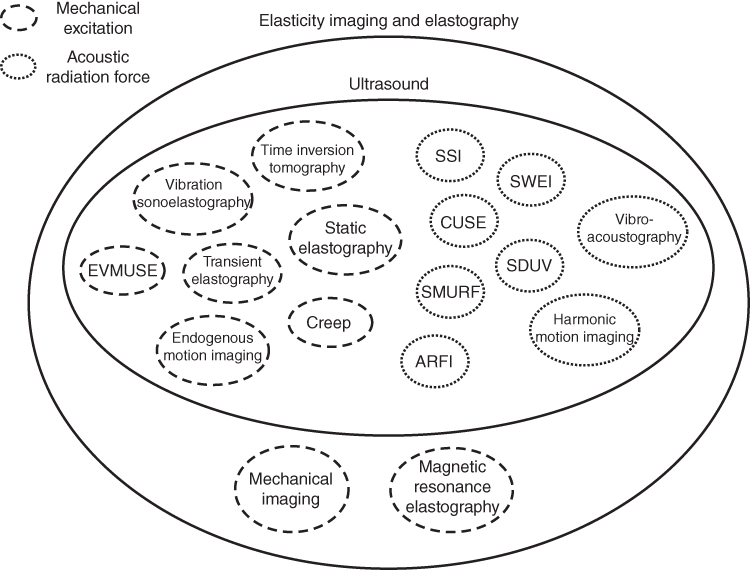
There are numerous methods that fall under the umbrella of the field of “ultrasound elastography” that have been detailed in previous chapters of this book. Figure 37.1 demonstrates the various techniques employed in the field of elastography and elasticity imaging as a whole [1–22]. This figure lists the various means of excitation. The methods use mechanical, endogenous, or acoustic radiation force as the deformation source.
Read now
Unlock full access


 O’Reilly covers everything we've got, with content to help us build a world-class technology community, upgrade the capabilities and competencies of our teams, and improve overall team performance as well as their engagement.I wanted to learn C and C++, but it didn't click for me until I picked up an O'Reilly book. When I went on the O’Reilly platform, I was astonished to find all the books there, plus live events and sandboxes so you could play around with the technology.I’ve been on the O’Reilly platform for more than eight years. I use a couple of learning platforms, but I'm on O'Reilly more than anybody else. When you're there, you start learning. I'm never disappointed.I'm always learning. So when I got on to O'Reilly, I was like a kid in a candy store. There are playlists. There are answers. There's on-demand training. It's worth its weight in gold, in terms of what it allows me to do.