September 2020
Intermediate to advanced
46 pages
46m
English
In the first chapter, we learned that Ray was created to address the need for flexible, efficient, and easy-to-use distributed computing, especially for newer machine learning systems like reinforcement learning, which are mostly written in Python. We also learned about the Ray ecosystem today.
In the last chapter, we saw Ray’s concise and intuitive but low-level API in action.
Now we’ll discuss several of the libraries made possible by Ray, which were drivers for the creation of Ray, too. They include Ray RLlib for reinforcement learning, Ray Tune for hyperparameter tuning, Ray S_GD_ for distributed training of TensorFlow and PyTorch models, and Ray Serve for model serving.
Reinforcement learning (RL) is a large and diverse subject. We can’t do it justice here, but we can explore the highlights and see how Ray RLlib enables RL practitioners to work efficiently. RLlib is also modular and flexible to support researchers exploring new RL algorithms and techniques.
So here goes a whirlwind tour of reinforcement learning. I’ll italicize popular terms as we encounter them. Consider Figure 3-1.
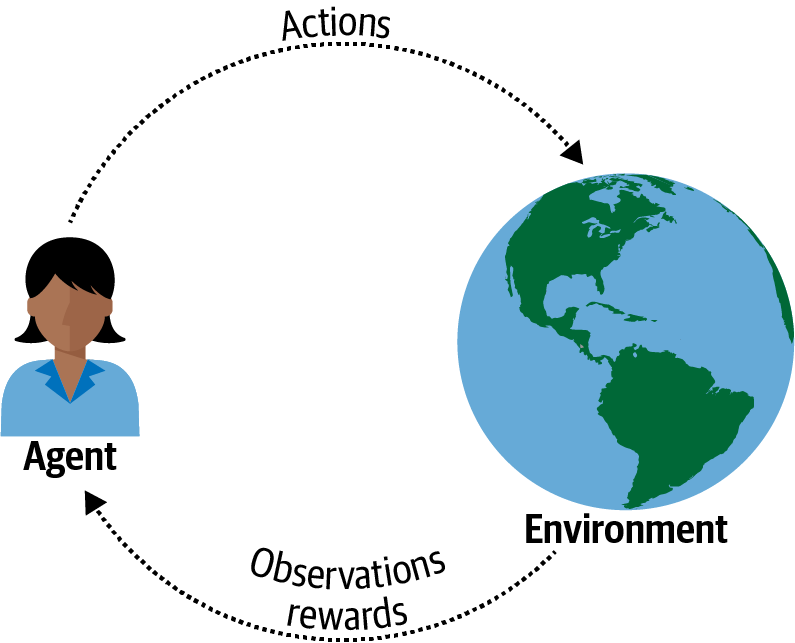
An agent takes actions in an environment, attempting to maximize a cumulative reward. At each step, the agent observes the environment’s current state and the reward received ...
Read now
Unlock full access


 O’Reilly covers everything we've got, with content to help us build a world-class technology community, upgrade the capabilities and competencies of our teams, and improve overall team performance as well as their engagement.I wanted to learn C and C++, but it didn't click for me until I picked up an O'Reilly book. When I went on the O’Reilly platform, I was astonished to find all the books there, plus live events and sandboxes so you could play around with the technology.I’ve been on the O’Reilly platform for more than eight years. I use a couple of learning platforms, but I'm on O'Reilly more than anybody else. When you're there, you start learning. I'm never disappointed.I'm always learning. So when I got on to O'Reilly, I was like a kid in a candy store. There are playlists. There are answers. There's on-demand training. It's worth its weight in gold, in terms of what it allows me to do.