April 2020
Intermediate
296 pages
7h 37m
English
In electrical engineering, a dual of a relationship is formed by interchanging voltage and current in an expression. The notion is more complex than that since reciprocal circuit elements also need to be considered. Basic electrical dualities are shown in Table B.1.
A simple example is Ohm's Law where we can write v = Ri and apply the principle of duality to derive i = Gv.
Duality means that the current or voltage in one circuit behaves in a similar manner as the voltage or current respectively, in another circuit. For example, if we apply a DC voltage V to a series RL circuit, then the equation to derive the current i is:
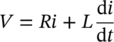
and the solution is
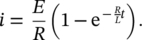
Now take a parallel RC circuit and inject a current I for which the corresponding equation and solution for the common voltage v are:
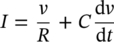
and
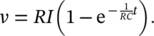
Clearly, by making the duality conversions given in Table B.1, either set of equations can be derived from the other and duality exists between the two cases.
Duality also exists between series and parallel RLC circuits but care needs to be exercised in applying it. Duality ...
Read now
Unlock full access


 O’Reilly covers everything we've got, with content to help us build a world-class technology community, upgrade the capabilities and competencies of our teams, and improve overall team performance as well as their engagement.I wanted to learn C and C++, but it didn't click for me until I picked up an O'Reilly book. When I went on the O’Reilly platform, I was astonished to find all the books there, plus live events and sandboxes so you could play around with the technology.I’ve been on the O’Reilly platform for more than eight years. I use a couple of learning platforms, but I'm on O'Reilly more than anybody else. When you're there, you start learning. I'm never disappointed.I'm always learning. So when I got on to O'Reilly, I was like a kid in a candy store. There are playlists. There are answers. There's on-demand training. It's worth its weight in gold, in terms of what it allows me to do.