December 2003
Intermediate to advanced
416 pages
13h 50m
English
Remember that one of the main goals of the design of the Domain Name System was to decentralize administration? This is achieved through delegation. Delegating domains works a lot like delegating tasks at work. A manager may break up a large project into smaller tasks and delegate responsibility for each of these tasks to different employees.
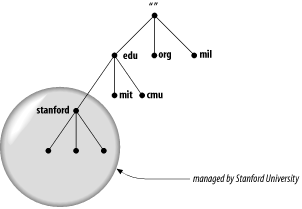
Likewise, an organization administering a domain can divide it into subdomains. Each of those subdomains can be delegated to other organizations. This means that an organization becomes responsible for maintaining all the data in that subdomain. It can freely change the data and even divide its subdomain into more subdomains and delegate those. The parent domain retains only pointers to sources of the subdomain’s data, so that it can refer queriers there. The domain stanford.edu, for example, is delegated to the folks at Stanford who run the university’s networks (see Figure 2-7).
 |
Not all organizations delegate away their whole domain, just as not all managers delegate all their work. A domain may have several delegated subdomains and also contain hosts that don’t belong in the subdomains. For example, the Acme Corporation (it supplies a certain coyote with most of his gadgets), which has a division in Rockaway and its headquarters in Kalamazoo, might have a rockaway.acme.com ...
Read now
Unlock full access


 O’Reilly covers everything we've got, with content to help us build a world-class technology community, upgrade the capabilities and competencies of our teams, and improve overall team performance as well as their engagement.I wanted to learn C and C++, but it didn't click for me until I picked up an O'Reilly book. When I went on the O’Reilly platform, I was astonished to find all the books there, plus live events and sandboxes so you could play around with the technology.I’ve been on the O’Reilly platform for more than eight years. I use a couple of learning platforms, but I'm on O'Reilly more than anybody else. When you're there, you start learning. I'm never disappointed.I'm always learning. So when I got on to O'Reilly, I was like a kid in a candy store. There are playlists. There are answers. There's on-demand training. It's worth its weight in gold, in terms of what it allows me to do.