January 2020
Beginner
432 pages
11h 26m
English
In Chapter 3, we discussed modules as a collection of related code. However, architects typically think in terms of components, the physical manifestation of a module.
Developers physically package modules in different ways, sometimes depending on their development platform. We call physical packaging of modules components. Most languages support physical packaging as well: jar files in Java, dll in .NET, gem in Ruby, and so on. In this chapter, we discuss architectural considerations around components, ranging from scope to discovery.
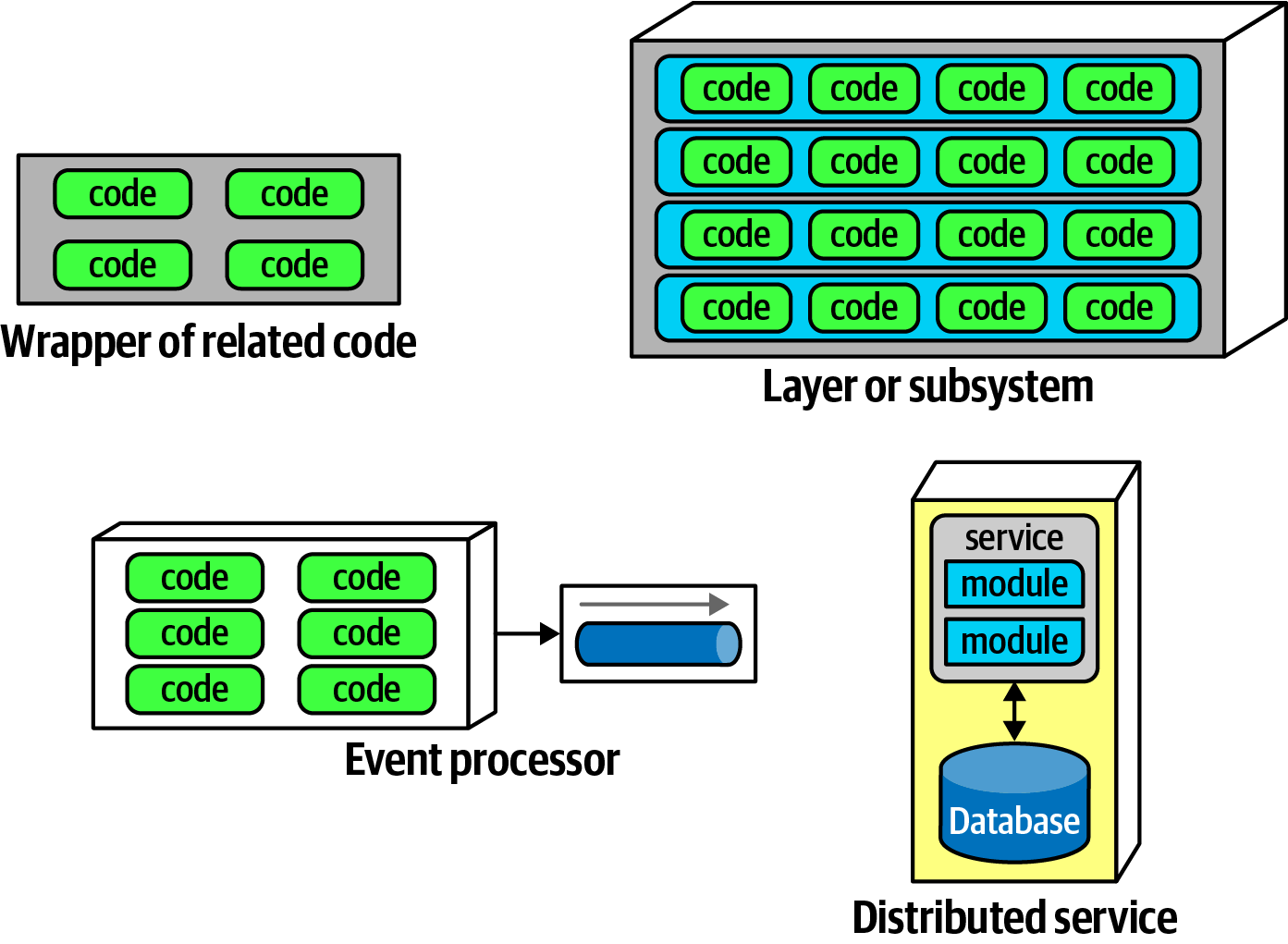
Developers find it useful to subdivide the concept of component based on a wide host of factors, a few of which appear in Figure 8-1.
Components offer a language-specific mechanism to group artifacts together, often nesting them to create stratification. As shown in Figure 8-1, the simplest component wraps code at a higher level of modularity than classes (or functions, in nonobject-oriented languages). This simple wrapper is often called a library, which tends to run in the same memory address as the calling code and communicate via language function call mechanisms. Libraries are usually compile-time dependencies (with notable exceptions like dynamic link libraries [DLLs] that were the bane of Windows users for many years).
Components also appear ...
Read now
Unlock full access


 O’Reilly covers everything we've got, with content to help us build a world-class technology community, upgrade the capabilities and competencies of our teams, and improve overall team performance as well as their engagement.I wanted to learn C and C++, but it didn't click for me until I picked up an O'Reilly book. When I went on the O’Reilly platform, I was astonished to find all the books there, plus live events and sandboxes so you could play around with the technology.I’ve been on the O’Reilly platform for more than eight years. I use a couple of learning platforms, but I'm on O'Reilly more than anybody else. When you're there, you start learning. I'm never disappointed.I'm always learning. So when I got on to O'Reilly, I was like a kid in a candy store. There are playlists. There are answers. There's on-demand training. It's worth its weight in gold, in terms of what it allows me to do.