January 2020
Beginner
432 pages
11h 26m
English
One of the fundamental styles in software architecture that appears again and again is the pipeline architecture (also known as the pipes and filters architecture). As soon as developers and architects decided to split functionality into discrete parts, this pattern followed. Most developers know this architecture as this underlying principle behind Unix terminal shell languages, such as Bash and Zsh.
Developers in many functional programming languages will see parallels between language constructs and elements of this architecture. In fact, many tools that utilize the MapReduce programming model follow this basic topology. While these examples show a low-level implementation of the pipeline architecture style, it can also be used for higher-level business applications.
The topology of the pipeline architecture consists of pipes and filters, illustrated in Figure 11-1.
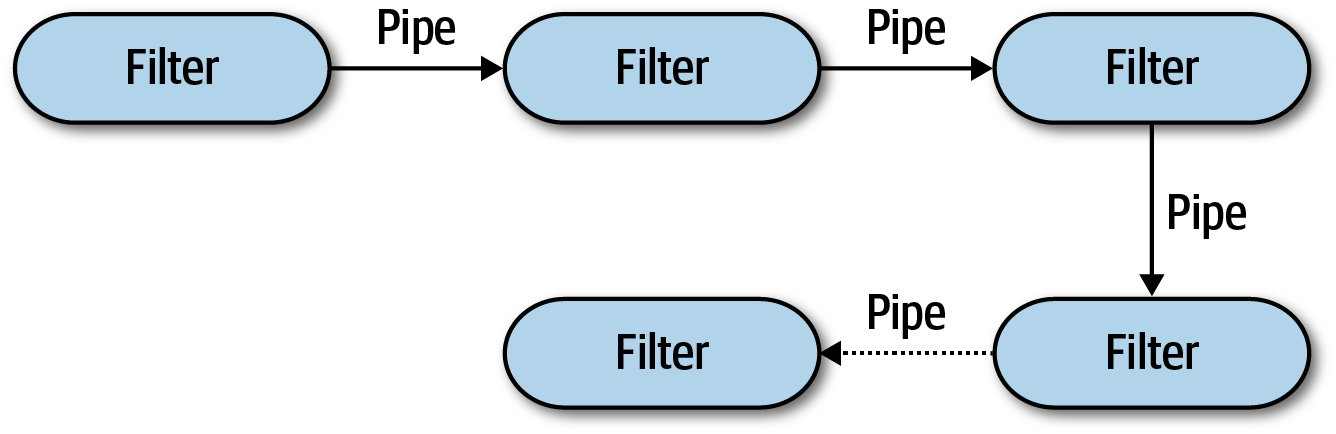
The pipes and filters coordinate in a specific fashion, with pipes forming one-way communication between filters, usually in a point-to-point fashion.
Pipes in this architecture form the communication channel between filters. Each pipe is typically unidirectional and point-to-point (rather than broadcast) for performance reasons, accepting input from one source and always directing output to another. The ...
Read now
Unlock full access


 O’Reilly covers everything we've got, with content to help us build a world-class technology community, upgrade the capabilities and competencies of our teams, and improve overall team performance as well as their engagement.I wanted to learn C and C++, but it didn't click for me until I picked up an O'Reilly book. When I went on the O’Reilly platform, I was astonished to find all the books there, plus live events and sandboxes so you could play around with the technology.I’ve been on the O’Reilly platform for more than eight years. I use a couple of learning platforms, but I'm on O'Reilly more than anybody else. When you're there, you start learning. I'm never disappointed.I'm always learning. So when I got on to O'Reilly, I was like a kid in a candy store. There are playlists. There are answers. There's on-demand training. It's worth its weight in gold, in terms of what it allows me to do.