February 1998
Beginner
224 pages
6h 28m
English
As discussed in the previous chapter, hierarchy is a familiar and powerful way of organizing information. In many cases, it makes sense for a hierarchy to form the foundation for organizing content in a web site. However, hierarchies can be fairly limiting from a navigation perspective. If you have ever used the ancient information browsing technology and precursor to the World Wide Web known as Gopher, you will understand the limitations of hierarchical navigation. In Gopherspace, you were forced to move up and down the tree structures of content hierarchies (see Figure 4.3). It was not practical to encourage or even allow jumps across branches (lateral navigation) or between multiple levels (vertical navigation) of a hierarchy.
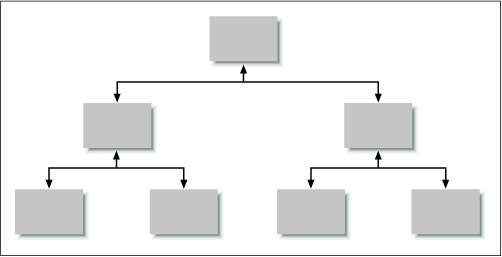
Figure 4-3. On a Gopher site, you could only move up or down through the tree structure of the hierarchy.
The Web’s hypertextual capabilities removed these limitations, allowing tremendous freedom of navigation. Hypertext supports both lateral and vertical navigation (see Figure 4.4). From any branch of the hierarchy, it is possible and often desirable to allow users to laterally move into other branches. For example, as you explore the Programs and Events section of a conference web site, you may decide to register for that conference. A hypertext link should allow you to jump to Registration without first retracing your steps ...
Read now
Unlock full access


 O’Reilly covers everything we've got, with content to help us build a world-class technology community, upgrade the capabilities and competencies of our teams, and improve overall team performance as well as their engagement.I wanted to learn C and C++, but it didn't click for me until I picked up an O'Reilly book. When I went on the O’Reilly platform, I was astonished to find all the books there, plus live events and sandboxes so you could play around with the technology.I’ve been on the O’Reilly platform for more than eight years. I use a couple of learning platforms, but I'm on O'Reilly more than anybody else. When you're there, you start learning. I'm never disappointed.I'm always learning. So when I got on to O'Reilly, I was like a kid in a candy store. There are playlists. There are answers. There's on-demand training. It's worth its weight in gold, in terms of what it allows me to do.