November 2008
Beginner
696 pages
17h 43m
English
If we simplify the mailbox analogy from earlier in the chapter, you can think of an array as a long row of slots into which you can place values. This single row of slots is called a one-dimensional array. Now imagine 10 rows of slots, stacked on top of each other. What you’re picturing is a classic two-dimensional array of rows and columns. The rows run across the array and the columns run up and down the array, as shown in Figure 10-2.
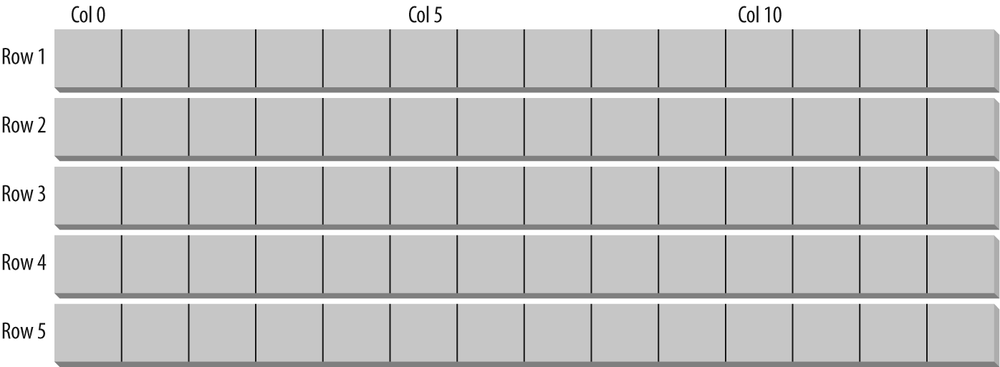
Figure 10-2. Rows and columns create a multidimensional array.
Two-dimensional arrays aren’t too hard to picture, but a third dimension is a bit harder to imagine, but still not too hard, if you remember your high school geometry. OK, now imagine four dimensions. Now imagine 10.
Those of you who are not string-theory physicists have probably given up, as have we. Maybe we can’t picture what 10-dimensional arrays look like, but that doesn’t matter to C#. Multidimensional arrays can be useful, even if you can’t quite picture them.
C# supports two types of multidimensional arrays: rectangular and jagged. In a rectangular array, every row is the same length. A jagged array, however, is an array of arrays, each of which can be a different length.
A rectangular array is an array of two (or more) dimensions. In the classic two-dimensional array, the first dimension is the number of rows and the second dimension is the ...
Read now
Unlock full access


 O’Reilly covers everything we've got, with content to help us build a world-class technology community, upgrade the capabilities and competencies of our teams, and improve overall team performance as well as their engagement.I wanted to learn C and C++, but it didn't click for me until I picked up an O'Reilly book. When I went on the O’Reilly platform, I was astonished to find all the books there, plus live events and sandboxes so you could play around with the technology.I’ve been on the O’Reilly platform for more than eight years. I use a couple of learning platforms, but I'm on O'Reilly more than anybody else. When you're there, you start learning. I'm never disappointed.I'm always learning. So when I got on to O'Reilly, I was like a kid in a candy store. There are playlists. There are answers. There's on-demand training. It's worth its weight in gold, in terms of what it allows me to do.