March 2019
Intermediate to advanced
504 pages
11h 3m
English
We begin this chapter with some notational issues. We shall strongly argue for a particular way of displaying the partial derivatives ∂fst(X)/∂xij of a matrix function F(X), one which generalizes the notion of a Jacobian matrix of a vector function to a Jacobian matrix of a matrix function.
For vector functions there is no controversy. Let f : S → ℝm be a vector function, defined on a set S in ℝn with values in ℝm. We have seen that if f is differentiable at a point x ∈ S, then its derivative Df(x) is an m × n matrix, also denoted by ∂f(x)/∂x′:
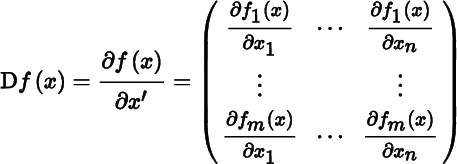
with, as a special case, for the scalar function ϕ (where m = 1):

The notation ∂f(x)/∂x′ has the advantage of bringing out the dimension: we differentiate m elements of a column with respect to n elements of a row, and the result is an m × n matrix. This is just handy notation, it is not conceptual.
However, the fact that the partial derivatives ∂fs(x)/∂xi are organized in an m × n matrix and not, for example, in an n × m matrix or an mn‐vector is conceptual and it matters. All mathematics texts define vector derivatives in this way. There is no controversy about vector derivatives; there is, however, some controversy about matrix derivatives and this needs to be resolved. ...
Read now
Unlock full access


 O’Reilly covers everything we've got, with content to help us build a world-class technology community, upgrade the capabilities and competencies of our teams, and improve overall team performance as well as their engagement.I wanted to learn C and C++, but it didn't click for me until I picked up an O'Reilly book. When I went on the O’Reilly platform, I was astonished to find all the books there, plus live events and sandboxes so you could play around with the technology.I’ve been on the O’Reilly platform for more than eight years. I use a couple of learning platforms, but I'm on O'Reilly more than anybody else. When you're there, you start learning. I'm never disappointed.I'm always learning. So when I got on to O'Reilly, I was like a kid in a candy store. There are playlists. There are answers. There's on-demand training. It's worth its weight in gold, in terms of what it allows me to do.