May 2026
Intermediate to advanced
378 pages
8h 17m
English
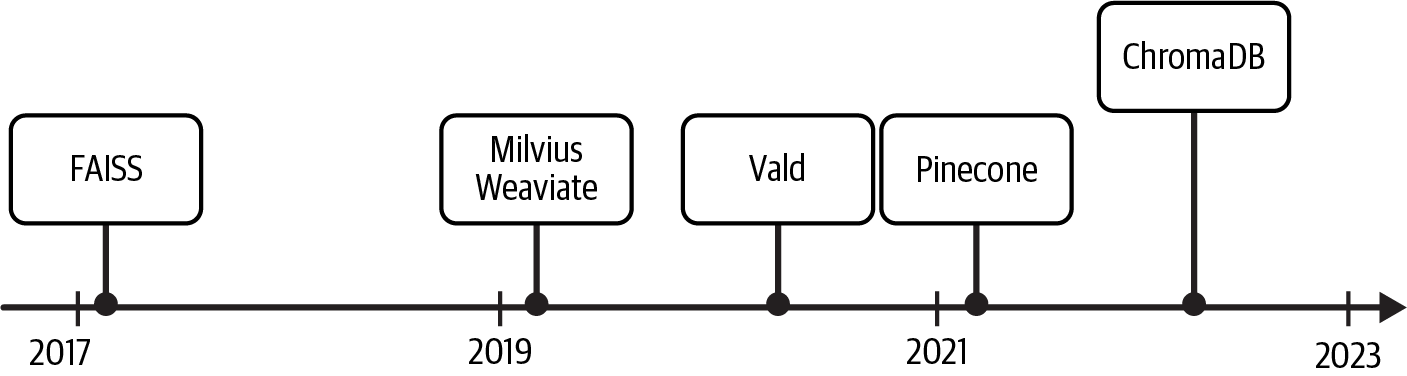
Vector databases have grown rapidly in popularity, especially since the rise of LLMs. Figure 6-1 shows some of the most popular vector databases and when they were released.
FAISS was released in 2017, followed by Milvus and Weaviate in 2019, Vald in 2020, Pinecone in 2021, and Chroma in 2023. At the same time, traditional databases such as PostgreSQL and Elasticsearch have added vector search features to their existing platforms. This means you don’t necessarily need to add a dedicated vector database to your tech stack if your existing SQL or NoSQL database already supports vector search.
This chapter introduces popular libraries and databases that support vector operations, including FAISS, Chroma, and PostgreSQL. You’ll learn how to choose the right vector store for your needs, implement similarity searches, and optimize performance by using indexing techniques.
Throughout this chapter, you’ll encounter both “similarity search” and “semantic search.” Similarity search refers to the technical operation of finding vectors that are close together in vector space. Semantic search describes the user-facing capability of searching by meaning rather than exact keywords. Semantic search is implemented using similarity search as its underlying mechanism.
You can find all the code examples ...
Read now
Unlock full access


 O’Reilly covers everything we've got, with content to help us build a world-class technology community, upgrade the capabilities and competencies of our teams, and improve overall team performance as well as their engagement.I wanted to learn C and C++, but it didn't click for me until I picked up an O'Reilly book. When I went on the O’Reilly platform, I was astonished to find all the books there, plus live events and sandboxes so you could play around with the technology.I’ve been on the O’Reilly platform for more than eight years. I use a couple of learning platforms, but I'm on O'Reilly more than anybody else. When you're there, you start learning. I'm never disappointed.I'm always learning. So when I got on to O'Reilly, I was like a kid in a candy store. There are playlists. There are answers. There's on-demand training. It's worth its weight in gold, in terms of what it allows me to do.