May 2026
Intermediate to advanced
378 pages
8h 17m
English
You can’t improve what you can’t measure. As you tune retrieval parameters, adjust prompts, or switch models, you need metrics that tell you whether changes help or hurt. Without evaluation, optimization becomes guesswork.
RAG evaluation requires different approaches than traditional machine learning (ML). In traditional ML, you train models to learn patterns from labeled data, then test whether they generalize to unseen examples. RAG systems don’t learn—they retrieve and generate. Foundation models already generalize across tasks. The question isn’t whether the model learned patterns, but whether it retrieved the right information and generated useful answers.
This difference shapes how you evaluate. The key challenge is that test questions should cover realistic user intent without appearing word for word in the system’s data, while remaining answerable from the available knowledge. Good generalization in RAG means handling different phrasings of the same underlying question. Intent matters more than exact wording. This affects test design—you reformulate real queries rather than split existing labeled examples.
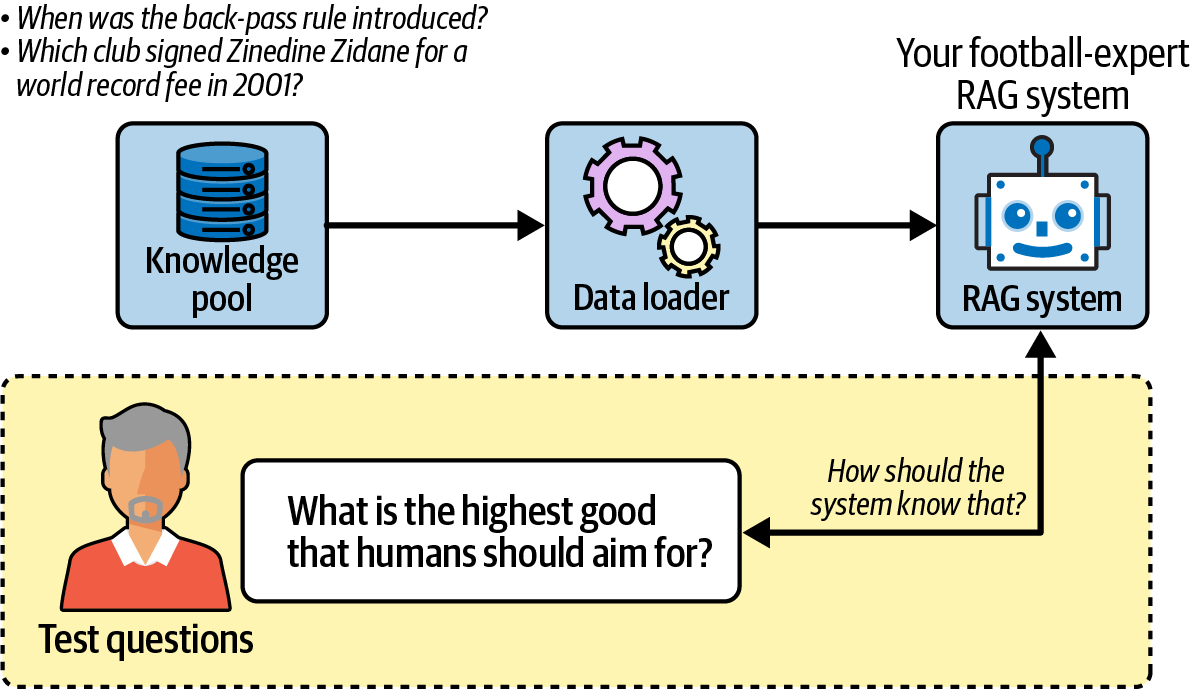
Figure 10-1 illustrates the problem: asking philosophical questions to a system that only knows football (soccer) rules produces meaningless evaluation results.
Read now
Unlock full access


 O’Reilly covers everything we've got, with content to help us build a world-class technology community, upgrade the capabilities and competencies of our teams, and improve overall team performance as well as their engagement.I wanted to learn C and C++, but it didn't click for me until I picked up an O'Reilly book. When I went on the O’Reilly platform, I was astonished to find all the books there, plus live events and sandboxes so you could play around with the technology.I’ve been on the O’Reilly platform for more than eight years. I use a couple of learning platforms, but I'm on O'Reilly more than anybody else. When you're there, you start learning. I'm never disappointed.I'm always learning. So when I got on to O'Reilly, I was like a kid in a candy store. There are playlists. There are answers. There's on-demand training. It's worth its weight in gold, in terms of what it allows me to do.