May 2026
Intermediate to advanced
378 pages
8h 17m
English
Agents are systems in which an LLM acts as a decision-maker. The model observes the current situation, plans a sequence of actions, and selects tools to execute those actions. Like a human who adjusts travel plans when a train is canceled, an agent adapts its strategy as new information becomes available (Figure 8-1).
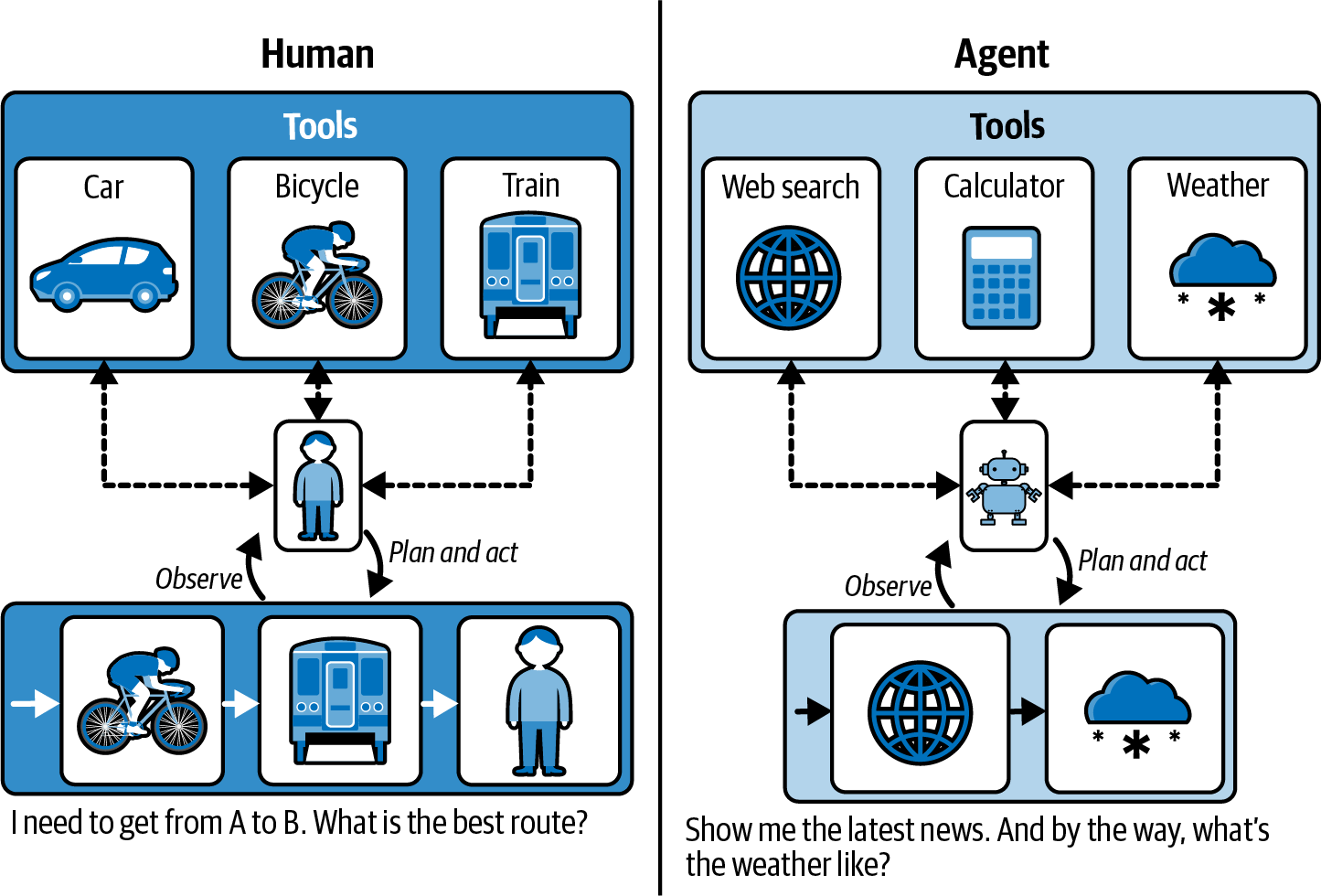
This way of thinking about problem-solving did not emerge overnight. Early LLM applications were built as isolated features such as summarization or translation. Over time, these grew into multistep workflows, and finally into fully agentic systems that can decide for themselves which tools to use.
Figure 8-2 shows the progression from single LLM features to orchestrated workflows to autonomous agents that freely select and combine tools.
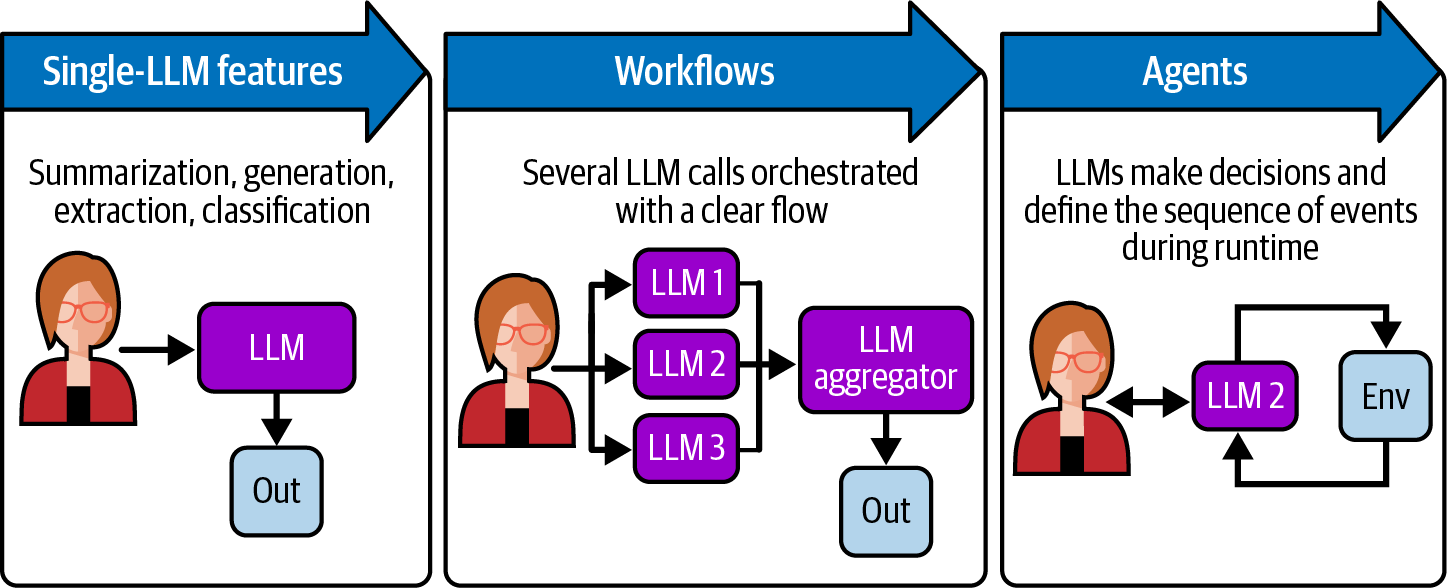
Once you view an agent as an autonomous problem solver, its internal structure becomes easier to reason about. At the core, an agent runs in a continuous loop. It performs an action, observes the result, and decides what to do next.
Figure 8-3 shows the main components that make this possible. The agent uses an LLM to reason and plan, relies on tools to perform actions, ...
Read now
Unlock full access


 O’Reilly covers everything we've got, with content to help us build a world-class technology community, upgrade the capabilities and competencies of our teams, and improve overall team performance as well as their engagement.I wanted to learn C and C++, but it didn't click for me until I picked up an O'Reilly book. When I went on the O’Reilly platform, I was astonished to find all the books there, plus live events and sandboxes so you could play around with the technology.I’ve been on the O’Reilly platform for more than eight years. I use a couple of learning platforms, but I'm on O'Reilly more than anybody else. When you're there, you start learning. I'm never disappointed.I'm always learning. So when I got on to O'Reilly, I was like a kid in a candy store. There are playlists. There are answers. There's on-demand training. It's worth its weight in gold, in terms of what it allows me to do.