March 2022
Intermediate to advanced
1136 pages
29h 55m
English
Our most basic optimization problem can be written
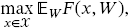 (4.1)
(4.1)
where x is our decision and W is any form of random variable. A simple example of this problem is the newsvendor problem which we might write

where x is a quantity of product we order at cost c, W is the demand, and we sell the smaller of x and W to the market at a price p.
This problem is the one most identified with the field that goes under the name of “stochastic search.” It is typically presented as a “static” stochastic optimization problem because it consists of making a single decision x, then observing an outcome W allowing us to assess the performance F(x, W), at which point we stop. However, this all depends on how we interpret “F(x, W),” “x,” and “W.”
For example, we can use F(x, W) to represent the results of running a simulation, a set of laboratory experiments, or the profits from managing a fleet of trucks. The input x could be the set of controllable inputs that govern the behavior of the simulator, the materials used in the laboratory experiments, or the size of our fleet of trucks. In addition, x could also be the parameters of a policy for making decisions, such as the order-up-to parameters θ = (θmin, θmax) in the inventory problem we introduced in section 1.3 ...
Read now
Unlock full access


 O’Reilly covers everything we've got, with content to help us build a world-class technology community, upgrade the capabilities and competencies of our teams, and improve overall team performance as well as their engagement.I wanted to learn C and C++, but it didn't click for me until I picked up an O'Reilly book. When I went on the O’Reilly platform, I was astonished to find all the books there, plus live events and sandboxes so you could play around with the technology.I’ve been on the O’Reilly platform for more than eight years. I use a couple of learning platforms, but I'm on O'Reilly more than anybody else. When you're there, you start learning. I'm never disappointed.I'm always learning. So when I got on to O'Reilly, I was like a kid in a candy store. There are playlists. There are answers. There's on-demand training. It's worth its weight in gold, in terms of what it allows me to do.