October 2004
Intermediate to advanced
256 pages
8h 16m
English
The SELinux security server makes two basic kinds of decisions:
Access decisions determine whether a given subject is allowed to perform a given operation on a given object.
Transition decisions, also called labeling decisions, determine the types assigned to newly created objects, particularly processes and files.
This section explains access decisions—the more frequently made and important of the two kinds of decisions—and the following section explains transition decisions.
Conceptually, each object class has an associated bitmap called an access vector, containing one bit for each action defined for the class. Figure 2-3 shows a simplified bitmap for the file class. An actual bitmap for the file class would include each of the more than one dozen actions defined for the file class, rather than merely the common actions shown in the figure.
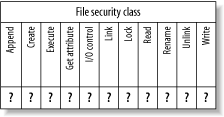
Figure 2-3. A simplified access vector for the file class
As explained earlier in this chapter, the SELinux security server makes access decisions by considering the security context of the subject and object of the action, the security class of the object, and the action requested. When the security server has made the access decision, it returns an access vector that indicates the allowed actions. More precisely, if the security server finds one or more policy rules matching the request, it ...
Read now
Unlock full access


 O’Reilly covers everything we've got, with content to help us build a world-class technology community, upgrade the capabilities and competencies of our teams, and improve overall team performance as well as their engagement.I wanted to learn C and C++, but it didn't click for me until I picked up an O'Reilly book. When I went on the O’Reilly platform, I was astonished to find all the books there, plus live events and sandboxes so you could play around with the technology.I’ve been on the O’Reilly platform for more than eight years. I use a couple of learning platforms, but I'm on O'Reilly more than anybody else. When you're there, you start learning. I'm never disappointed.I'm always learning. So when I got on to O'Reilly, I was like a kid in a candy store. There are playlists. There are answers. There's on-demand training. It's worth its weight in gold, in terms of what it allows me to do.