December 2007
Intermediate to advanced
224 pages
7h 18m
English
The structure of the MPEG Surround encoder is shown in Figure 6.4. A multi-channel input signal is first processed by a channel-dependent pre-gain. These gains enable adjustment of the level of certain channels (for example LFE and surround) within the transmitted down mix. Subsequently, the input signals are decomposed into time/frequency tiles using an analysis filter bank. A spatial encoder generates a down-mix signal and (encoded) spatial parameters for each time/frequency tile. These parameters are quantized and encoded into a parameter bitstream by a parameter encoder (Q). The down-mix is converted to the time domain using a synthesis filterbank. Finally, a post-gain is applied to control the overall signal level of the down-mix.
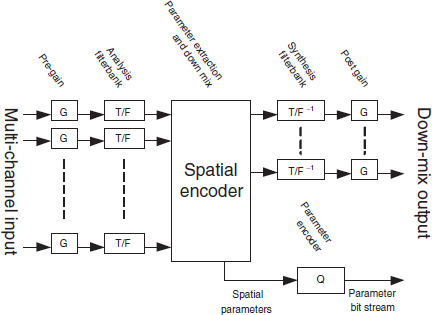
Figure 6.4 Structure of the MPEG Surround encoder. Reproduced by permission of the Audio Engineering Society, Inc, New York, USA.
In the process of down-mixing a multi-channel signal to a stereo signal, it is often desirable to have unequal weights for the different input channels. For example, the surround channels are often attenuated by 3 dB prior to the actual down-mix process. MPEG Surround supports user-controllable pre-gains between 0 and −6 dB, in steps of 1.5 dB. For the LFE, these weights are adjustable between 0 and −20 dB in steps of 5 dB.
The level of the generated down-mix ...
Read now
Unlock full access


 O’Reilly covers everything we've got, with content to help us build a world-class technology community, upgrade the capabilities and competencies of our teams, and improve overall team performance as well as their engagement.I wanted to learn C and C++, but it didn't click for me until I picked up an O'Reilly book. When I went on the O’Reilly platform, I was astonished to find all the books there, plus live events and sandboxes so you could play around with the technology.I’ve been on the O’Reilly platform for more than eight years. I use a couple of learning platforms, but I'm on O'Reilly more than anybody else. When you're there, you start learning. I'm never disappointed.I'm always learning. So when I got on to O'Reilly, I was like a kid in a candy store. There are playlists. There are answers. There's on-demand training. It's worth its weight in gold, in terms of what it allows me to do.