March 2019
Intermediate to advanced
352 pages
9h 26m
English
Transition from a helix conformation to a coil conformation of a polypeptide and vice versa is another phenomenon that a theoretical treatment similar to the one we learned in the 1D Ising model is effective. The theory was developed by Zimm and Bragg several decades ago [23]. The intuition they instilled in the model appears out‐of‐worldly, but it works and explains experimental results beautifully. We learn their model in this chapter.
A protein molecule is a sequence of amino acid residues (–NH–CHR–CO–, where R varies from residue to residue), and its sequence is given. Interactions between atoms or groups of atoms within the molecule force it to adopt a specific structure in three dimensions when the large molecule folds. We recognize a helix form (called α‐helix) and a sheet form (β‐sheet) in some parts of the folded structure. The α‐helix is made possible through a twist favored by bulky side groups R bonded to the chiral carbon atom and supported by hydrogen bonds between the proton in NH within the residue and the oxygen atom in CO a few residues away along the linear‐chain backbone (see Figure 13.1).
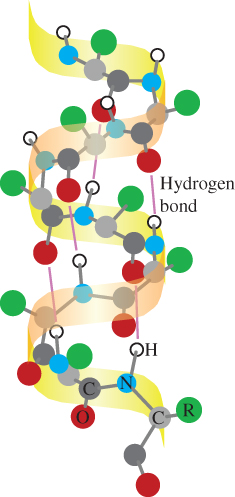
Figure 13.1 α‐Helix in a protein molecule. A hydrogen bond forms between the proton in NH and the oxygen atom in C = O across a few residues. Hydrogen atoms on the carbon atoms bonded to side groups R are not shown.
Read now
Unlock full access


 O’Reilly covers everything we've got, with content to help us build a world-class technology community, upgrade the capabilities and competencies of our teams, and improve overall team performance as well as their engagement.I wanted to learn C and C++, but it didn't click for me until I picked up an O'Reilly book. When I went on the O’Reilly platform, I was astonished to find all the books there, plus live events and sandboxes so you could play around with the technology.I’ve been on the O’Reilly platform for more than eight years. I use a couple of learning platforms, but I'm on O'Reilly more than anybody else. When you're there, you start learning. I'm never disappointed.I'm always learning. So when I got on to O'Reilly, I was like a kid in a candy store. There are playlists. There are answers. There's on-demand training. It's worth its weight in gold, in terms of what it allows me to do.