July 2009
Intermediate to advanced
600 pages
19h 50m
English
To understand the basis of the real options argument and the reasons for its allure, it is easiest to go back to the risk-assessment tool unveiled in Chapter 3—decision trees. Figure 5.1 shows a simple example of a decision tree.
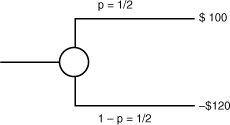
Given the equal probabilities of up and down movements, and the larger potential loss, the expected value for this investment is negative:
| Expected Value = 0.50 (100) + 0.5 (–120) = –$10 |
Now contrast this with the slightly more complicated two-phase decision tree shown in Figure 5.2.
Note that the total potential profits ...
Read now
Unlock full access


 O’Reilly covers everything we've got, with content to help us build a world-class technology community, upgrade the capabilities and competencies of our teams, and improve overall team performance as well as their engagement.I wanted to learn C and C++, but it didn't click for me until I picked up an O'Reilly book. When I went on the O’Reilly platform, I was astonished to find all the books there, plus live events and sandboxes so you could play around with the technology.I’ve been on the O’Reilly platform for more than eight years. I use a couple of learning platforms, but I'm on O'Reilly more than anybody else. When you're there, you start learning. I'm never disappointed.I'm always learning. So when I got on to O'Reilly, I was like a kid in a candy store. There are playlists. There are answers. There's on-demand training. It's worth its weight in gold, in terms of what it allows me to do.