July 2018
Beginner
336 pages
11h 58m
English
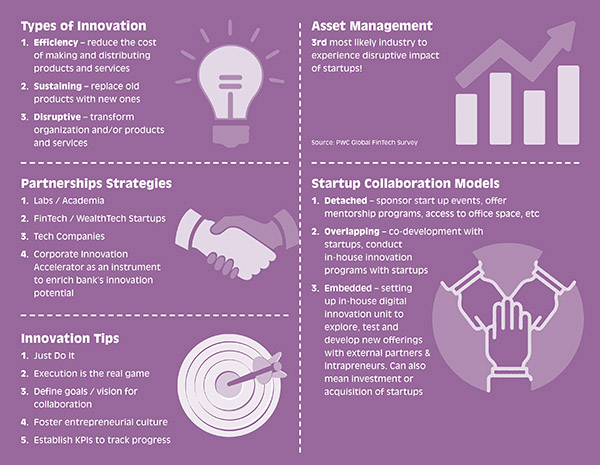
Innovation has become a key priority for most banks and asset managers, however really transforming an organization and changing its culture into a more agile, entrepreneurial structure is easier said than done. Today’s digitization efforts of banks mostly focus on client channels and back-office automation, thereby neglecting the creation of new business and revenue models, new innovative products and solutions, and digital content. Wealth management decisions are still predominantly based on expert human judgement. However, by sticking to traditional investment concepts, banks risk losing ground to more innovative new market entrants in the FinTech and WealthTech space and challenger banks. Banks who digitize their wealth management and offer digital solutions in coexistence with traditional ones will capitalize on growth opportunities and strengthen their profitability. In general, innovation has four core characteristics. First, innovations relate to an object like a product, a process or a business model. Second, innovations can either be incremental or radical/disruptive, depending on their potential to change existing products and/or industry structures. Third, innovations require a structured approach to a company’s innovation management capabilities – like incubators, open application programming interfaces (APIs), etc. Fourth, ...
Read now
Unlock full access


 O’Reilly covers everything we've got, with content to help us build a world-class technology community, upgrade the capabilities and competencies of our teams, and improve overall team performance as well as their engagement.I wanted to learn C and C++, but it didn't click for me until I picked up an O'Reilly book. When I went on the O’Reilly platform, I was astonished to find all the books there, plus live events and sandboxes so you could play around with the technology.I’ve been on the O’Reilly platform for more than eight years. I use a couple of learning platforms, but I'm on O'Reilly more than anybody else. When you're there, you start learning. I'm never disappointed.I'm always learning. So when I got on to O'Reilly, I was like a kid in a candy store. There are playlists. There are answers. There's on-demand training. It's worth its weight in gold, in terms of what it allows me to do.