December 2005
Intermediate to advanced
1066 pages
33h 38m
English
Early Linux kernels had L3 protocols call functions provided by neighboring protocols directly. The IPv4 subsystem, therefore, interacted directly with the ARP code. In recent versions of the kernel, developers have identified common requirements for different protocols and have abstracted them into a new layer called the neighboring infrastructure.
Because the kernel still includes old pieces of code that have not been updated to the
new, protocol-independent layer, you can still find direct calls to a few deprecated
functions of the ARP code (e.g., arp_find), but they
are exceptions. The section "Common Interface
Between L3 Protocols and Neighboring Protocols" in Chapter 27 discusses in detail the interface to
the neighboring infrastructure.
Figure 26-5 shows the key parts of Linux's neighboring subsystems and the other parts of the kernel with which they interact. The L3 protocols interact with the neighboring layer via a common interface, which uses the right neighboring protocol (ARP, ND, etc.) depending on the L3 protocol that is asking for the service.[*]
When transmitting a packet, the following steps take place:
The routing subsystem of the local host selects the L3 destination address (the next hop).
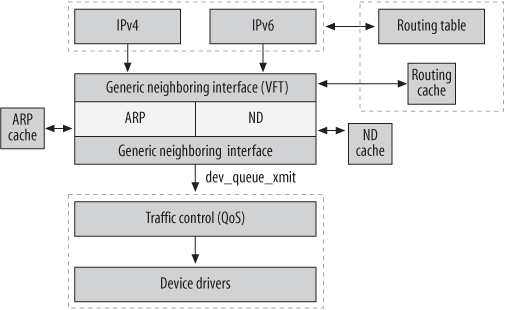
Figure 26-5. The big picture
If according to the routing table, this hop is on the same network (if, that is, the next hop is a neighbor), the neighboring layer ...
Read now
Unlock full access


 O’Reilly covers everything we've got, with content to help us build a world-class technology community, upgrade the capabilities and competencies of our teams, and improve overall team performance as well as their engagement.I wanted to learn C and C++, but it didn't click for me until I picked up an O'Reilly book. When I went on the O’Reilly platform, I was astonished to find all the books there, plus live events and sandboxes so you could play around with the technology.I’ve been on the O’Reilly platform for more than eight years. I use a couple of learning platforms, but I'm on O'Reilly more than anybody else. When you're there, you start learning. I'm never disappointed.I'm always learning. So when I got on to O'Reilly, I was like a kid in a candy store. There are playlists. There are answers. There's on-demand training. It's worth its weight in gold, in terms of what it allows me to do.