April 2008
Intermediate
832 pages
26h 2m
English
We now illustrate the use of the variance relation (15.40) in evaluating the steady-state performance of the sign-error LMS algorithm,
for which

where the data {d(i),ui,v(i)} are assumed to satisfy model (15.16). To proceed, we need to distinguish between real-valued data and complex-valued data. This is because the definition of the sign function is different in both cases. The final expressions for the EMSE, however, will turn out to be identical except for a scaling factor.
In this case the sign function is defined as
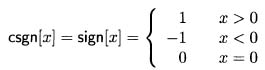
Using the fact that g2(x) = 1 almost everywhere on the real line, the variance relation (15.40) becomes
In order to arrive at the value of the EMSE we need to evaluate the expectation on the right-hand side. For this purpose, we shall rely on the following assumption:
This condition is violated in general. For example, even if we assume that v(i) and ui in model (15.16)
Read now
Unlock full access


 O’Reilly covers everything we've got, with content to help us build a world-class technology community, upgrade the capabilities and competencies of our teams, and improve overall team performance as well as their engagement.I wanted to learn C and C++, but it didn't click for me until I picked up an O'Reilly book. When I went on the O’Reilly platform, I was astonished to find all the books there, plus live events and sandboxes so you could play around with the technology.I’ve been on the O’Reilly platform for more than eight years. I use a couple of learning platforms, but I'm on O'Reilly more than anybody else. When you're there, you start learning. I'm never disappointed.I'm always learning. So when I got on to O'Reilly, I was like a kid in a candy store. There are playlists. There are answers. There's on-demand training. It's worth its weight in gold, in terms of what it allows me to do.

