April 2008
Intermediate
832 pages
26h 2m
English
In this chapter we describe two classes of unitary transformations (Givens and Householder) that can be used to annihilate selected entries in a vector or matrix and thereby reduce a matrix to triangular (or similar) form, as is often required by array algorithms. Special care needs to be taken when dealing with complex-valued data as compared to real-valued data.
Givens rotations provide an effective way to annihilate specific entries in a vector and it is enough to explain their operation on 2-dimensional row vectors. We consider the case of real-valued data first.
Consider a 1 × 2 real-valued vector z = [ a b ], and assume that we wish to determine a 2 × 2 matrix Θ that transforms it to the form:
for some real number α to be determined, and where Θ is required to be orthogonal, i.e., it should satisfy

We refer to [a b] as the pre-array and to [α 0] as the post-array.
Now any orthogonal matrix Θ has the important property that it preserves vector norms. Indeed, it is easy to see from (34.1) that the following equality must hold:
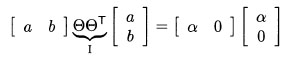
or, equivalently, a2 + b2 = α2. In this way, no matter which orthogonal ...
Read now
Unlock full access


 O’Reilly covers everything we've got, with content to help us build a world-class technology community, upgrade the capabilities and competencies of our teams, and improve overall team performance as well as their engagement.I wanted to learn C and C++, but it didn't click for me until I picked up an O'Reilly book. When I went on the O’Reilly platform, I was astonished to find all the books there, plus live events and sandboxes so you could play around with the technology.I’ve been on the O’Reilly platform for more than eight years. I use a couple of learning platforms, but I'm on O'Reilly more than anybody else. When you're there, you start learning. I'm never disappointed.I'm always learning. So when I got on to O'Reilly, I was like a kid in a candy store. There are playlists. There are answers. There's on-demand training. It's worth its weight in gold, in terms of what it allows me to do.