October 2003
Beginner
734 pages
16h 56m
English
Remember for a Remote client, the only local comparison you do is on two stub objects, using equals(). This doesn’t work when you want to compare something back on the server, in this case the two EJB object references. That’s what isIdentical() is for. But local clients have the real thing! They have the real reference to the EJB object, so they can use equals(), to see if two EJB object (local) references are meaningfully equivalent. But... that’s still not what you want. There is no guarantee in the spec, for the results you’ll get with .equals()! So while it seems like you could just use .equals() rather than isIdentical() with a local client, the spec does not guarantee that the results will be the same. Bottom line: if you want to know if two EJB object references are referencing the same session object, you have to use isIdentical() even when the EJB object is local.
REMOTE client view
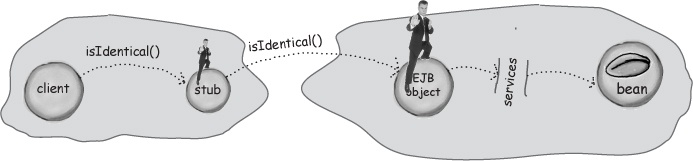
A Remote client has to make a Remote method call, isIdentical(), to get meaningful comparison info about an EJB object. Calling equals() on a stub won’t tell you anything useful.
LOCAL client view
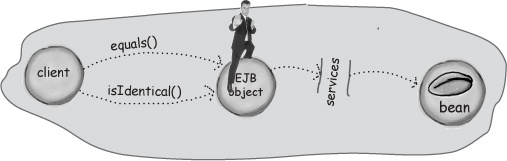
Calling equals() and isIdentical() on a local EJB object reference are not guaranteed to give you the same result. You ...
Read now
Unlock full access


 O’Reilly covers everything we've got, with content to help us build a world-class technology community, upgrade the capabilities and competencies of our teams, and improve overall team performance as well as their engagement.I wanted to learn C and C++, but it didn't click for me until I picked up an O'Reilly book. When I went on the O’Reilly platform, I was astonished to find all the books there, plus live events and sandboxes so you could play around with the technology.I’ve been on the O’Reilly platform for more than eight years. I use a couple of learning platforms, but I'm on O'Reilly more than anybody else. When you're there, you start learning. I'm never disappointed.I'm always learning. So when I got on to O'Reilly, I was like a kid in a candy store. There are playlists. There are answers. There's on-demand training. It's worth its weight in gold, in terms of what it allows me to do.