October 2003
Beginner
734 pages
16h 56m
English
The stateful version of the client adds two things not in the stateless version:
We’re passing an argument to the create() method.
A stateful bean can (and often does) have arguments to create methods, so that the client can pass in client-specific state for the bean to save and use in later “conversations” with the client (i.e. later method calls from that client).
We’re calling remove() on the component interface.
It’s polite for the client to tell the Container that she’s done with a stateful session bean. And now you know why. Without the remove() call, the Container will hold on to the bean, wastefully, until the bean times out. So in this case “polite” really means “improves scalability”.
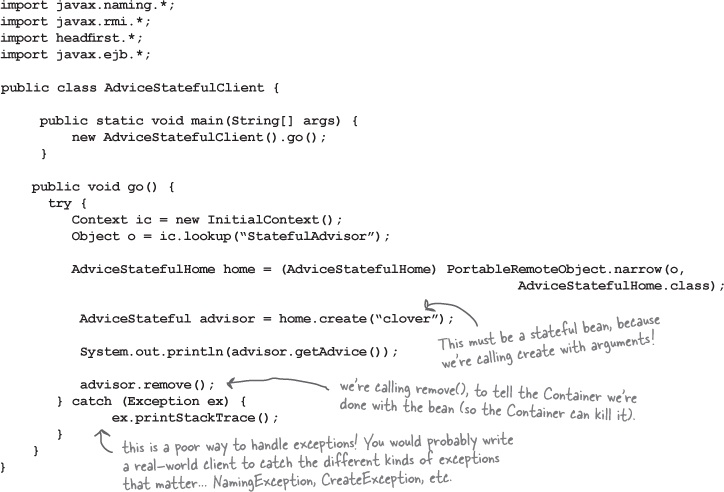
You must be able to recognize whether the client is for a stateful bean.
You must be able to look at client code, like this, and know whether the client’s bean is stateful. If the client calls a no-arg create(), there’s no way to know whether it IS stateless, but at least you know it MIGHT be. If the create has args, or a name other than create() (like, createAccount()), you know the bean must be stateful.
Read now
Unlock full access


 O’Reilly covers everything we've got, with content to help us build a world-class technology community, upgrade the capabilities and competencies of our teams, and improve overall team performance as well as their engagement.I wanted to learn C and C++, but it didn't click for me until I picked up an O'Reilly book. When I went on the O’Reilly platform, I was astonished to find all the books there, plus live events and sandboxes so you could play around with the technology.I’ve been on the O’Reilly platform for more than eight years. I use a couple of learning platforms, but I'm on O'Reilly more than anybody else. When you're there, you start learning. I'm never disappointed.I'm always learning. So when I got on to O'Reilly, I was like a kid in a candy store. There are playlists. There are answers. There's on-demand training. It's worth its weight in gold, in terms of what it allows me to do.