December 2002
Intermediate to advanced
260 pages
9h 18m
English
It’s important to understand that when I refer to a RAID array, I’m talking about a block device and not a filesystem. You could think of the relationship between the two much in the same way you might think of the relationship between a house and its foundation. If the foundation is weak, the house will eventually collapse. The filesystem, which represents the house in my analogy, is built on top of a block device. Normally, a block device is a single hard disk, but RAID introduces another layer (see Figure 1-5). RAID groups many block devices into a single virtual device.
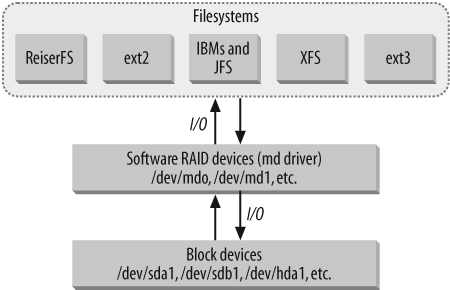
This means that Linux interacts with an array through a single block device having a single major and minor number. Physically, the array device points to many different physical disks, each with their own major and minor numbers. Programmers might think of this model the same way they think of an array data type, hence the use of the word “array” in the RAID acronym.
Each piece of hardware connected to a Linux system is assigned a major and minor number. The major number refers to a specific group of hardware (such as small computer systems interface, or SCSI, disks), while the minor uniquely identifies each installed piece of hardware within the group (for example, each individual SCSI disk). Since RAID is merely ...
Read now
Unlock full access


 O’Reilly covers everything we've got, with content to help us build a world-class technology community, upgrade the capabilities and competencies of our teams, and improve overall team performance as well as their engagement.I wanted to learn C and C++, but it didn't click for me until I picked up an O'Reilly book. When I went on the O’Reilly platform, I was astonished to find all the books there, plus live events and sandboxes so you could play around with the technology.I’ve been on the O’Reilly platform for more than eight years. I use a couple of learning platforms, but I'm on O'Reilly more than anybody else. When you're there, you start learning. I'm never disappointed.I'm always learning. So when I got on to O'Reilly, I was like a kid in a candy store. There are playlists. There are answers. There's on-demand training. It's worth its weight in gold, in terms of what it allows me to do.