December 2002
Intermediate to advanced
260 pages
9h 18m
English
RAID-1 provides the most complete form of redundancy because it can survive multiple disk failures without the need for special data recovery algorithms. Data is mirrored block-by-block onto each member disk (see Figure 2-7). So for every N disks in a RAID-1, the array can withstand a failure of N-1 disks without data loss. In a four-disk RAID-1, up to three disks could be lost without loss of data.
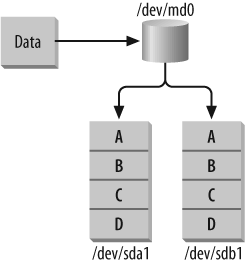
As the number of member disks in a mirror increases, the write performance of the array decreases. Each write incurs a performance hit because each block must be written to each participating disk. However, a substantial advantage in read performance is achieved through parallel access. Duplicate copies of data on different hard drives allow the system to make concurrent read requests.
For example, let’s examine the read and write operations of a two-disk RAID-1. Let’s say that I’m going to perform a database query to display a list of all the customers that have ordered from my company this year. Fifty such customers exist, and each of their customer data records is 1 KB. My RAID-1 array receives a request to retrieve these fifty customer records and output them to my company’s sales engineer. The drives in my array store data in 1 KB chunks and support a data throughput of 1 KB at a time. However, my controller card and system bus support ...
Read now
Unlock full access


 O’Reilly covers everything we've got, with content to help us build a world-class technology community, upgrade the capabilities and competencies of our teams, and improve overall team performance as well as their engagement.I wanted to learn C and C++, but it didn't click for me until I picked up an O'Reilly book. When I went on the O’Reilly platform, I was astonished to find all the books there, plus live events and sandboxes so you could play around with the technology.I’ve been on the O’Reilly platform for more than eight years. I use a couple of learning platforms, but I'm on O'Reilly more than anybody else. When you're there, you start learning. I'm never disappointed.I'm always learning. So when I got on to O'Reilly, I was like a kid in a candy store. There are playlists. There are answers. There's on-demand training. It's worth its weight in gold, in terms of what it allows me to do.