June 2012
Intermediate to advanced
912 pages
23h 35m
English
Chapter 14
Report Builder Solution Strategies
What's in this chapter?
Planning a self-service reporting strategy
Report ownership
Data governance
Folder management and report branding
Semantic models
Using shared data sources and datasets
Using report parts
User report migration strategies
Since Reporting Services 2008, Report Builder has become the primary method for report designers to create standard RDL-based reports. As you know, two report design tools are targeted to serve different report design audiences, but they share a lot of the same functionality and capabilities. In short, SQL Server Data Tools (SSDT) is primarily for IT professionals and developer teams to collaborate and design report solutions. Report Builder is for business-focused report designers to create individual reports using published resources on the server. However, both tools support basic and advanced report design capabilities. One doesn't replace the other, and one isn't necessarily better than the other. It depends on the needs and the person performing the task.
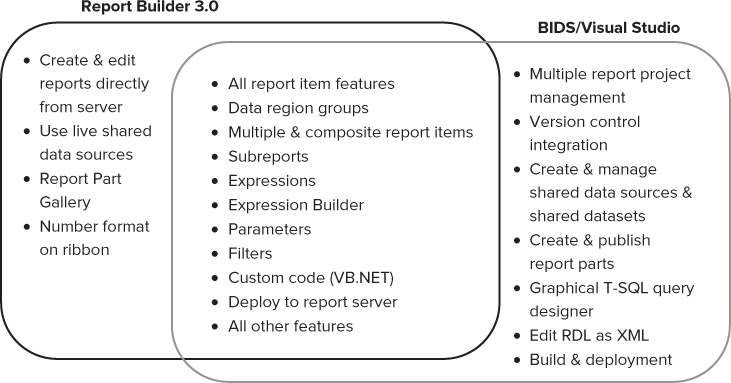
Figure 14.1 shows the major feature differences and similarities between the Report Builder and SSDT design tools.
As you can see, these design tools share core capabilities, making them suited to mainstream report design. Many professional designers don't have a strong preference. Some who do simply prefer to use the tool ...
Read now
Unlock full access


 O’Reilly covers everything we've got, with content to help us build a world-class technology community, upgrade the capabilities and competencies of our teams, and improve overall team performance as well as their engagement.I wanted to learn C and C++, but it didn't click for me until I picked up an O'Reilly book. When I went on the O’Reilly platform, I was astonished to find all the books there, plus live events and sandboxes so you could play around with the technology.I’ve been on the O’Reilly platform for more than eight years. I use a couple of learning platforms, but I'm on O'Reilly more than anybody else. When you're there, you start learning. I'm never disappointed.I'm always learning. So when I got on to O'Reilly, I was like a kid in a candy store. There are playlists. There are answers. There's on-demand training. It's worth its weight in gold, in terms of what it allows me to do.