August 2011
Beginner to intermediate
688 pages
21h 28m
English

I always heard it couldn't be done, but sometimes it don't always work.
–Casey Stengel
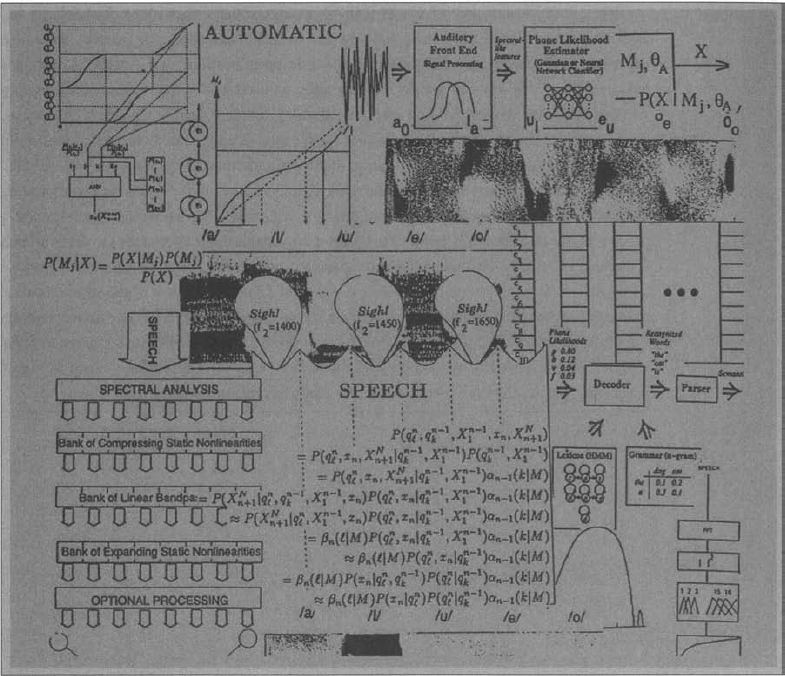
BUILDING ON both the mathematical techniques of Part II and the feature extraction methods of Part V, we now focus on a single important application area: speech recognition. We describe a major aspect of speech-recognition systems in each of the eight chapters in Part VI. In Chapter 22, we extend the archetypal processing paradigms of Part V to the style of signal-processing features that are most commonly used for 1998 ASR systems. Chapter 23 introduces the linguistic categories that are most frequently used in such systems, such as phones and phonemes. The next two chapters describe methods for determining a sequence of words from measures of the similarity or dissimilarity between training examples of words and new test data. In both cases, the primary technique described is a search method known as dynamic programming. In Chapter 24, distance between sounds in training versus test examples is used as the measure of dissimilarity. Although this approach per se is rarely used today, its description can often be a useful introduction to more advanced techniques. In Chapter 25, the statistical generalization of this approach is developed, and its relation ...
Read now
Unlock full access


 O’Reilly covers everything we've got, with content to help us build a world-class technology community, upgrade the capabilities and competencies of our teams, and improve overall team performance as well as their engagement.I wanted to learn C and C++, but it didn't click for me until I picked up an O'Reilly book. When I went on the O’Reilly platform, I was astonished to find all the books there, plus live events and sandboxes so you could play around with the technology.I’ve been on the O’Reilly platform for more than eight years. I use a couple of learning platforms, but I'm on O'Reilly more than anybody else. When you're there, you start learning. I'm never disappointed.I'm always learning. So when I got on to O'Reilly, I was like a kid in a candy store. There are playlists. There are answers. There's on-demand training. It's worth its weight in gold, in terms of what it allows me to do.