August 2011
Beginner to intermediate
688 pages
21h 28m
English

And computers are getting smarter all the time; scientists tell us that soon they will be able to talk with us. (By “they,” I mean computers; I doubt scientists will ever be able to talk to us.)
–Dave Barry
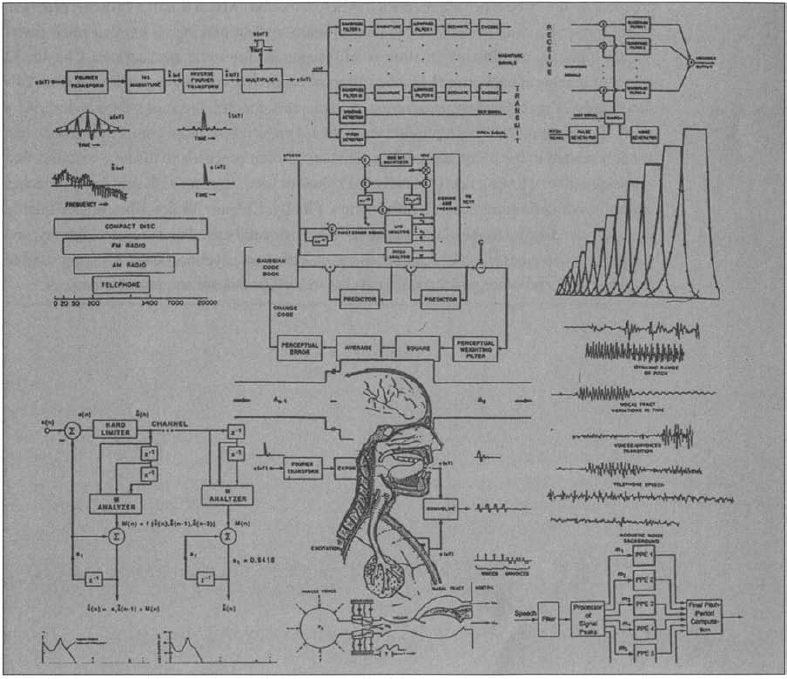
IN PART VII we proceed to applications for which a speech signal is generated for human listeners. As with recognition, we begin with classical methods and then extend the discussion to the more refined approaches that are current.
Chapter 30 describes the basics of speech-synthesis systems. Although many modern systems are concatenative, newer approaches based on statistical analysis-synthesis methods are also discussed, as well as several methods that are of historical interest. Chapter 31 proceeds to describe basic approaches to pitch detection, which is still a difficult problem. Many modern coding systems avoid this difficulty by not making an explicit pitch determination per se, but this information is still important for some applications. Chapter 32 provides a general background for the different classes of vocoders; as with Chapter 24's description of deterministic recognition systems, this chapter does not so much describe a method in current practice as provide background material for more complex methods that are still related to the ...
Read now
Unlock full access


 O’Reilly covers everything we've got, with content to help us build a world-class technology community, upgrade the capabilities and competencies of our teams, and improve overall team performance as well as their engagement.I wanted to learn C and C++, but it didn't click for me until I picked up an O'Reilly book. When I went on the O’Reilly platform, I was astonished to find all the books there, plus live events and sandboxes so you could play around with the technology.I’ve been on the O’Reilly platform for more than eight years. I use a couple of learning platforms, but I'm on O'Reilly more than anybody else. When you're there, you start learning. I'm never disappointed.I'm always learning. So when I got on to O'Reilly, I was like a kid in a candy store. There are playlists. There are answers. There's on-demand training. It's worth its weight in gold, in terms of what it allows me to do.