December 2011
Intermediate to advanced
444 pages
15h 10m
English
So far, then, our suggested overall design for the running example looks like Figure C-7 below.
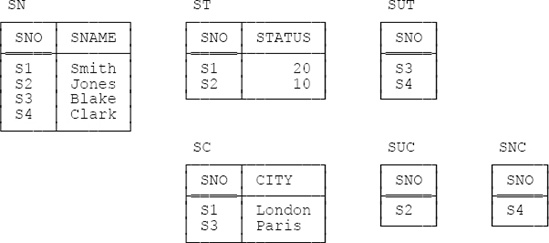
Figure C-7. Fully decomposing table S
I’m assuming here, and will continue to assume for the rest of this appendix, that there’s just one reason why STATUS values might be missing (viz., we don’t know the value) and just two reasons why CITY values might be missing (viz., either we don’t know the value or no such value exists). Note, however, that the design of Figure C-7 requires certain constraints to be satisfied in order to hold it together, so to speak. To be specific, the following constraints need to be stated and enforced:
Each table has {SNO} as a key.
Each row in SN has a matching row in exactly one of ST and SUT, and conversely.
Each row in SN has a matching row in exactly one of SC, SUC, and SNC, and conversely.
Of course, the first of these is just a conventional key constraint on each of the six tables; it can thus be expressed by means of conventional KEY specifications. As for the other two, they can easily be expressed in Tutorial D using D_UNION, as follows:[191]
     CONSTRAINT EQD2
         SN { SNO } = D_UNION { ST { SNO } , SUT { SNO } } ;

     CONSTRAINT EQD3
         SN { SNO } = D_UNION { SC { SNO } , SUC { SNO } , SNC { SNO } } ;
Aside: Actually it might not be a good idea to use D_UNION in a constraint as I’ve just done. After all, if some update violates the constraint in question, ...
Read now
Unlock full access


 O’Reilly covers everything we've got, with content to help us build a world-class technology community, upgrade the capabilities and competencies of our teams, and improve overall team performance as well as their engagement.I wanted to learn C and C++, but it didn't click for me until I picked up an O'Reilly book. When I went on the O’Reilly platform, I was astonished to find all the books there, plus live events and sandboxes so you could play around with the technology.I’ve been on the O’Reilly platform for more than eight years. I use a couple of learning platforms, but I'm on O'Reilly more than anybody else. When you're there, you start learning. I'm never disappointed.I'm always learning. So when I got on to O'Reilly, I was like a kid in a candy store. There are playlists. There are answers. There's on-demand training. It's worth its weight in gold, in terms of what it allows me to do.