March 2020
Intermediate to advanced
327 pages
8h 1m
English
Generally speaking, XXE is indeed easy to defend against—simply disable external entities in your XML parser (see Figure 24-1). How this is done depends on the XML parser in question, but is typically just a single line of configuration:
factory.setFeature("http://apache.org/xml/features/disallow-doctype-decl",true);
XXE is noted by OWASP to be particularly dangerous against Java-based XML parsers, as many have XXE enabled by default. Depending on the language and parser you are relying on, it is possible that XXE is disabled by default.
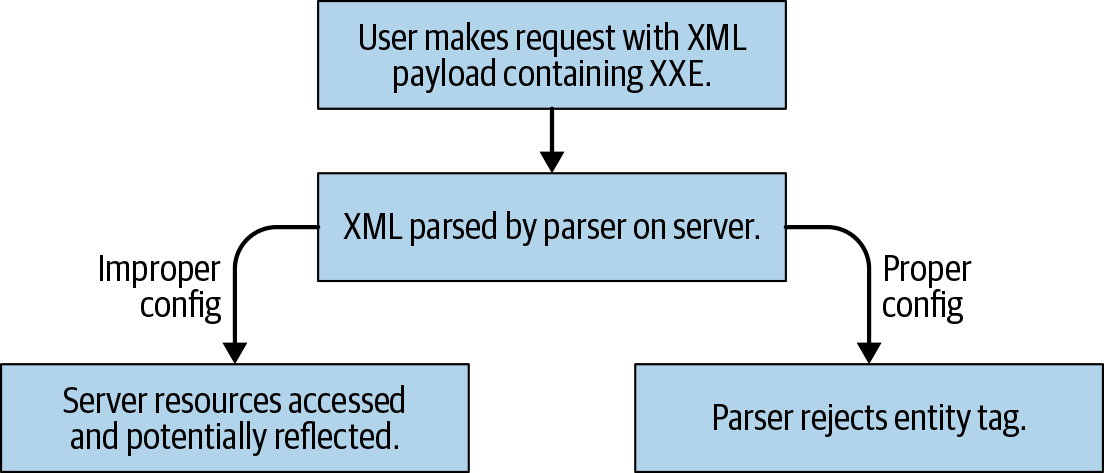
You should always check your XML parser’s API documentation to make sure, and not just expect it is disabled by default.
Depending on your application’s use cases, it may be possible to re-architecture the application to rely on a different data format rather than XML. This type of change could simplify the codebase, while eliminating any XXE risk. Typically, XML can be interchanged with JSON, making JSON the default when looking at other formats.
JSON, on the other hand, would not be practical if your application is parsing actual XML, SVG, or other XML-derived file types. It would, however, be a practical solution if your application is sending standard hierarchical payloads that just happen ...
Read now
Unlock full access


 O’Reilly covers everything we've got, with content to help us build a world-class technology community, upgrade the capabilities and competencies of our teams, and improve overall team performance as well as their engagement.I wanted to learn C and C++, but it didn't click for me until I picked up an O'Reilly book. When I went on the O’Reilly platform, I was astonished to find all the books there, plus live events and sandboxes so you could play around with the technology.I’ve been on the O’Reilly platform for more than eight years. I use a couple of learning platforms, but I'm on O'Reilly more than anybody else. When you're there, you start learning. I'm never disappointed.I'm always learning. So when I got on to O'Reilly, I was like a kid in a candy store. There are playlists. There are answers. There's on-demand training. It's worth its weight in gold, in terms of what it allows me to do.